
Saturday, April 11, 2015
How to make cork popping bugs and why you should avoid them that all costs
Our lab was undergoing a major renovation, and all stuff had to be removed from the north wing. It had been a chemistry lab for decades, but had been shut down for 20 years. Good stuff got saved, surplused, sent to other labs, or donated to high school chemistry programs. But there was still a ton of junk left that was destined for the dumpster. Our solution was to put it out on the free table for a day or two for anyone to take, and then finally send it to the junkyard. I had a moment of nostalgia when a big bag of vintage cork test tube stoppers showed up and I got the idea of using them to create some of the vintage poppers of my youth. This went south in a heartbeat.
First, cork poppers have been supplanted almost completely by foam, and I now know why. They are a pain. First, you have to shape the cork. This is done by sanding, but there really is not an effective way of holding the cork other than to run a needle through it. This may or may not hold. Once you do get it sanded, it usually has pits that need to be filled to give it that smooth surface. I rooted around the shop for wood filler and it worked, sort of.
There is one decent website that advises using an acrylic paint called ceramcote for filling and sealing. It works, but is so thick that it has to be painted on with a decent brush to not leave streaks. I had more success dipping them in a thinned mixture. But the real challenge is finding the right hook, and getting the cork mounted securely.
Cork poppers traditionally used a hump shank hook. These are still available (Mustad 33903) but this part drove me nuts because nearly every cork popper I have ever seen has a hook that seems to be about two sizes too small for the body. I wonder how they ever hook a fish. And I now know why. If you try to put a traditional cork head on larger hook, the hook diameter and shank kink are big enough to make it difficult. I ended up cutting a narrow notch to make it fit, and squeezing it back together gently in a vise after filling the notch with a drop of superglue. Most of my poppers looked like they were suffering from a bad case of eczema, but a trip to the drug store for emery boards made them look better. I then found that many, many, thinned coats of ceramcote are needed to get that nice finish you see on the racks of them that used to hang on cards in the hardware store. And by the way, coat the hook shank with tying thread if you really want any durability. Until I did that the prototypes would just twist around pretty easily.
I have a rule never to tie more than 3 or 4 of any prototype pattern in case it does not cast, stay together, or catch fish. Those four poppers have been on the bench for weeks, and I still need a couple more coats of varnish before they are even close to being ready. Those bags of pre-shaped foam ones and stinger hooks are looking better and better. It would be interesting to know how they actually mass-produced them back in the day, because I can't envision a production process that would allow them to be sold for the ridiculously low prices they sold for. I remember 3 or 4 for a dollar.
And by the way, I do not do any hackle wraps and have found they cast better and catch as many fish with just a sparse bucktail tail.


Saturday, November 22, 2014
Vanguard Binoculars and not exactly about fly fishing
I am doing a couple of odd posts because there wasn't much fly fishing this year. It was a rainy cool summer, and every weekend the rivers were too blown out to bother fishing, unless you owned a drift boat, and had a fishing partner capable of helping you row while you threw giant streamers and poppers. So I worked on getting ready for serious deer hunting.
Last year I had a new experience- big woods hunting for deer up along the NY/PA border. This is very different from Michigan hunting, where you put on about 17 layers of clothing and sit in one place for hours hoping something will pass by. It involves light clothing, and tracking. You work you way through the woods until you pick up a track, then follow it until you see the animal that made it. No matter where it goes, and for several miles. My two friends Matt and Mike excel at this, but for me it was a learning experience. In addition to more stamina, lighter clothing, organization skills, experience, skill, and woodcraft, they both had another thing I lacked: good binoculars. As they tracked, they would constantly glass the area in front of them. I had a cheap-ass pair of binocs that were so lame I did not like using them, and on two occasions I spooked deer that I should have or could have seen had I scanned. So I decided to get a real pair of hunting binocs.
Went to a big box outdoor store that had every brand ever made and tried them all. I had never looked through 20 different brands and models at once the differences were amazing. There were sort of three levels of optics: the 100 to 150 dollar range, the 350-450 dollar range, and then the insane dollar range. The expensive ones were not a possibility, and I was getting vexed because I did not see that much difference between the cheaper and mid-price brands that would justify the cost. I had about settled on an inexpensive pair that has become very popular with deer hunters, and then ran into the Vanguard rep. He asked me if I had tried their brand, and I said "no, because I have never heard of them." He handed me a pair of ED-II 8 x 30's (400 bucks), and I focused them on the eye chart that someone in the store had cleverly taped to a heating duct about 75 yards away. Whoa. It was the only pair where I could read the entire chart, and there was far less distortion at the edge of field. Color was spot on. Light. They were by far better than others in the same price, and even better than some of the more expensive ones. I took a pair home.
Vanguard is not new, but for years they made optics sold as house brands in other stores. They felt they could do better, and started selling their own stuff.
Anyway, the field testing was even better. They really are waterproof (although legally advertised as only water resistant), armored, light, and they do not fog up. Whoever designed the focus and diopter knobs was actually a hunter, because you can use both with gloves in really, really, cold weather. The part I like best is the focus, which is neither too coarse (you are rotating the knob back and forth to dial it in to the tiny sweet spot) or too fine (endless rotation to have an effect by which time the deer is out of sight). They are the binocs that I can look through all day without eye strain, and they added a new dimension to my experience. Although a hunting binocular, you could use these as your primary birding binocs too.
Note that I have no financial interest, and the bitches would not discount them for me either. I paid full price. But this is a rare case where I found something so good I wanted to tell other people about it. If you hunt, beg for these to appear under the tree this Christmas.
Last year I had a new experience- big woods hunting for deer up along the NY/PA border. This is very different from Michigan hunting, where you put on about 17 layers of clothing and sit in one place for hours hoping something will pass by. It involves light clothing, and tracking. You work you way through the woods until you pick up a track, then follow it until you see the animal that made it. No matter where it goes, and for several miles. My two friends Matt and Mike excel at this, but for me it was a learning experience. In addition to more stamina, lighter clothing, organization skills, experience, skill, and woodcraft, they both had another thing I lacked: good binoculars. As they tracked, they would constantly glass the area in front of them. I had a cheap-ass pair of binocs that were so lame I did not like using them, and on two occasions I spooked deer that I should have or could have seen had I scanned. So I decided to get a real pair of hunting binocs.
Went to a big box outdoor store that had every brand ever made and tried them all. I had never looked through 20 different brands and models at once the differences were amazing. There were sort of three levels of optics: the 100 to 150 dollar range, the 350-450 dollar range, and then the insane dollar range. The expensive ones were not a possibility, and I was getting vexed because I did not see that much difference between the cheaper and mid-price brands that would justify the cost. I had about settled on an inexpensive pair that has become very popular with deer hunters, and then ran into the Vanguard rep. He asked me if I had tried their brand, and I said "no, because I have never heard of them." He handed me a pair of ED-II 8 x 30's (400 bucks), and I focused them on the eye chart that someone in the store had cleverly taped to a heating duct about 75 yards away. Whoa. It was the only pair where I could read the entire chart, and there was far less distortion at the edge of field. Color was spot on. Light. They were by far better than others in the same price, and even better than some of the more expensive ones. I took a pair home.
Vanguard is not new, but for years they made optics sold as house brands in other stores. They felt they could do better, and started selling their own stuff.
Anyway, the field testing was even better. They really are waterproof (although legally advertised as only water resistant), armored, light, and they do not fog up. Whoever designed the focus and diopter knobs was actually a hunter, because you can use both with gloves in really, really, cold weather. The part I like best is the focus, which is neither too coarse (you are rotating the knob back and forth to dial it in to the tiny sweet spot) or too fine (endless rotation to have an effect by which time the deer is out of sight). They are the binocs that I can look through all day without eye strain, and they added a new dimension to my experience. Although a hunting binocular, you could use these as your primary birding binocs too.
Note that I have no financial interest, and the bitches would not discount them for me either. I paid full price. But this is a rare case where I found something so good I wanted to tell other people about it. If you hunt, beg for these to appear under the tree this Christmas.
Monday, May 26, 2014
The Best Emerald Shiner Pattern Ever

I have long wondered about streamer patterns, and what I wonder is if any of the originators ever actually saw a real prey fish. The smelt imitations are the worst, but other minnow imitations are almost as bad. This one has been working like a charm on smallmouth, and it has supplanted most of my previous favorite patterns. I can take some credit, but it was based on a pattern I saw years ago by Bill Murdoch of the Tampa Bay fly fishing club. Anyway, I actually designed it to look like an emerald shiner. If you choose not to tie it, then it is on you because I gave you the pattern.
Hook: Gamakatsu B10S stinger, size 2
Body: none, but I am planning to tie a few with a thin copper flashabou wrap to resemble the lateral line. A base of white thread with pearl flashabou would probably be OK too, but you do not need a body.
Wing: A good bunch of white bucktail. Then layer 10-15 strands of chartreuse bucktail and a half dozen pieces of pearl Flashabou. Then 10-15 strands of olive bucktail, and 8-10 strands of green flashabou. More strands for bling, fewer for subtle. Top with either peacock herl or a synthetic substitute. I like herl better because nothing matches it, but flashabou is more durable, so I often used some of each.
Head: the tiedown of all those bulky materials leaves sort of a mess, so I put in a few wraps of red stuff to cover it all. You could use flashabou or krystal flash, but I think the one in the photo used red micro chenille or wool. This is optional, but it makes the fly look cool. Then wrap a fairly large head and whip finish. Twice. The head should be substantial to provide a base for the eyes.
Eyes: stick on fake eyes with superglue. Then add some of that UV cure clearcoat if you have it, or epoxy if you don't. I use Solarez because it is cheap and someday I might want to take up surfing and repair my surfboard. You need just enough to hold the eyes on permanently.
Emerald shiners were formerly common in the Great Lakes but became rare after Alewife proliferated. Recent declines in alewife have led to a comback, and everyone eats them. This fly gave me my best "insane numbers of really big smallmouth bass" day, the fly in the photo was the actual fly that provided the experience.
The one drawback to this pattern is that the materials occasionally wrap around the shank during fishing. It can't be helped (or at least I can't figure out a way to stop it) so you have to check it occasionally. To me, this is minor because it produces so well, but I had to point that out. But it is durable, the fly above is still pretty after over 25 bass.
Saturday, March 22, 2014
The double strike indicator revisited with remarkably bad photos

A reader asked me to post a photo of the double strike indicator rig. This was the only way to portray it, but you can see the two Kahuna strike indicator pieces that have been slid into position and secured by blood knots below each one. Gotta tell you, they seem kind of dumb when you are fishing for hard hitting smallmouth bass, but they will inform you of a surprising number of gentle takes that you would miss, or not detect for a few moments. The trick is to watch the two in relation to each other, and typically one starts moving in a different direction from the other. A blast to fish.
Thursday, March 13, 2014
Jeez, time flies
I had not put up any new posts for about a year, and had sort of lost interest in blogging. But then I went to the Midwest Fly Fishing Expo, and actually ran into 1) someone who had read my blog and liked it, and 2) encouraged me get the thing up and running again. Wow. Pretty pathetic that all it takes is one positive comment and I am again typing away, but hope springs eternal in the human heart.
The past year has been busy with the following events:
My first Montana trip in years, with the most uneven fishing I have ever experienced. There were good days, and poor days, and even one close to skunk day when I caught nothing. About 15 minutes before total darkness I tied on the biggest wooly bugger in the box and started swinging it aimlessly. Caught a nice rainbow as the sun set. On the other hand, on another day I hooked a Chinook sized brown on a size 18 BWO nymph presented with a cane rod. It didn't last long, but it was glorious. And I did land a huge rainbow that rocketed up from the depths of a tiny pool up in the Gallatin headwaters to take a dry fly. So going back for more.
A night where I stood on a rock and caught over 30 large smallmouth from a single spot. After it finally died down I made a cast back to the rock itself and hooked the largest fish I have taken from that river. Nineteen inches, but rather slim and only a few pounds.
Answered a craigslist ad for large lot of fly tying material, and when I picked it up the guy said "there was more stuff under the steps than I thought, so there are some extra boxes of junk". The extra boxes were filled with unopened Metz saddles in their original bags. I recouped the cost by selling 2 of the 3 vises I found in the stash, and most of the nylon rod winding thread.
Did a wonderful hunt with two friends from grad school in the big woods country of Pennsylvania. No deer were harmed, but I saw more in one day than in several years of hunting in Michigan. That along with all sorts of wildlife sightings.
My lovely and adorable wife got me a Dyna King vise for Christmas. They are worth every penny she paid.
Started making cane rods again after a long stretch of not making them.
Waited patiently for Orvis to call me with an offer of a Helios2 and Mirage reel if they could include the smiling minnow in their catalog. Still hopeful, but I might have to send them some. Seriously, I have gotten a lot of feedback on the pattern. Everyone says the exact same thing:" I thought you were nuts, but that thing really works!" You heard it here first. New readers, check out the older posts.
Watched my beloved Michigan Department of Natural resources be transformed from a resource management agency into an arm of Michigan's agriculture, logging, and mining industries via the worst legislature in the history of this state.
The past year has been busy with the following events:
My first Montana trip in years, with the most uneven fishing I have ever experienced. There were good days, and poor days, and even one close to skunk day when I caught nothing. About 15 minutes before total darkness I tied on the biggest wooly bugger in the box and started swinging it aimlessly. Caught a nice rainbow as the sun set. On the other hand, on another day I hooked a Chinook sized brown on a size 18 BWO nymph presented with a cane rod. It didn't last long, but it was glorious. And I did land a huge rainbow that rocketed up from the depths of a tiny pool up in the Gallatin headwaters to take a dry fly. So going back for more.
A night where I stood on a rock and caught over 30 large smallmouth from a single spot. After it finally died down I made a cast back to the rock itself and hooked the largest fish I have taken from that river. Nineteen inches, but rather slim and only a few pounds.
Answered a craigslist ad for large lot of fly tying material, and when I picked it up the guy said "there was more stuff under the steps than I thought, so there are some extra boxes of junk". The extra boxes were filled with unopened Metz saddles in their original bags. I recouped the cost by selling 2 of the 3 vises I found in the stash, and most of the nylon rod winding thread.
Did a wonderful hunt with two friends from grad school in the big woods country of Pennsylvania. No deer were harmed, but I saw more in one day than in several years of hunting in Michigan. That along with all sorts of wildlife sightings.
My lovely and adorable wife got me a Dyna King vise for Christmas. They are worth every penny she paid.
Started making cane rods again after a long stretch of not making them.
Waited patiently for Orvis to call me with an offer of a Helios2 and Mirage reel if they could include the smiling minnow in their catalog. Still hopeful, but I might have to send them some. Seriously, I have gotten a lot of feedback on the pattern. Everyone says the exact same thing:" I thought you were nuts, but that thing really works!" You heard it here first. New readers, check out the older posts.
Watched my beloved Michigan Department of Natural resources be transformed from a resource management agency into an arm of Michigan's agriculture, logging, and mining industries via the worst legislature in the history of this state.
Wednesday, February 13, 2013
How to save badly used and matted flies
Put them in a hemostat and hold them in the steam from a tea kettle for a few seconds.They will be like new unless chewed excessively by fish.
I thought that everyone knew about this but I learned that this trick has been largely forgotten.
I thought that everyone knew about this but I learned that this trick has been largely forgotten.
Tuesday, January 22, 2013
The ultimate round goby fly
 | |||||
| I decided to reward all the readers who are still visiting after the NRA post with something useful. if you do not know about it, round gobies invaded the Great Lakes during the late 1990's and are now ubiquitous. They have many negative effects, but are eaten by just about every predator out there, including Atlantic salmon. Everyone eats gobies, and anglers have begun using goby imitations (most states prohibit their use as live bait). Berkeley actually makes a power bait in the size and shape of a goby, and there are a variety of soft plastic baits that imitate them. These are especially popular with smallmouth bass anglers. There are also a variety of fly patterns out there, but I just was not satisfied with any of them. They either swam with the hook down, were very difficult to tie, or just did not look like a goby to me. Now, you know well of my disdain for those who modify a famous pattern with a minute change and name it after themselves, but I decided that would try to create a new goby pattern. Here it is. |
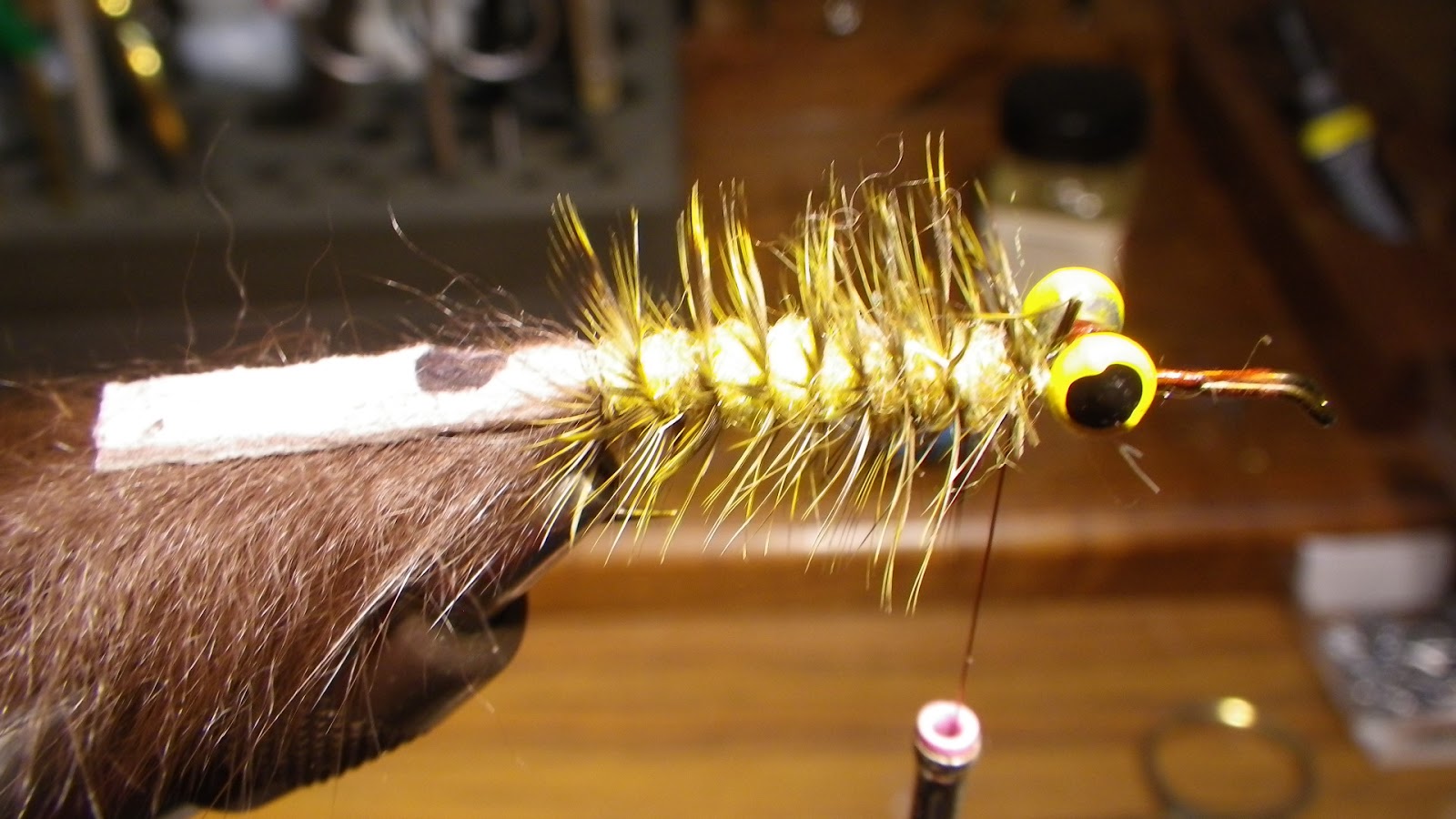


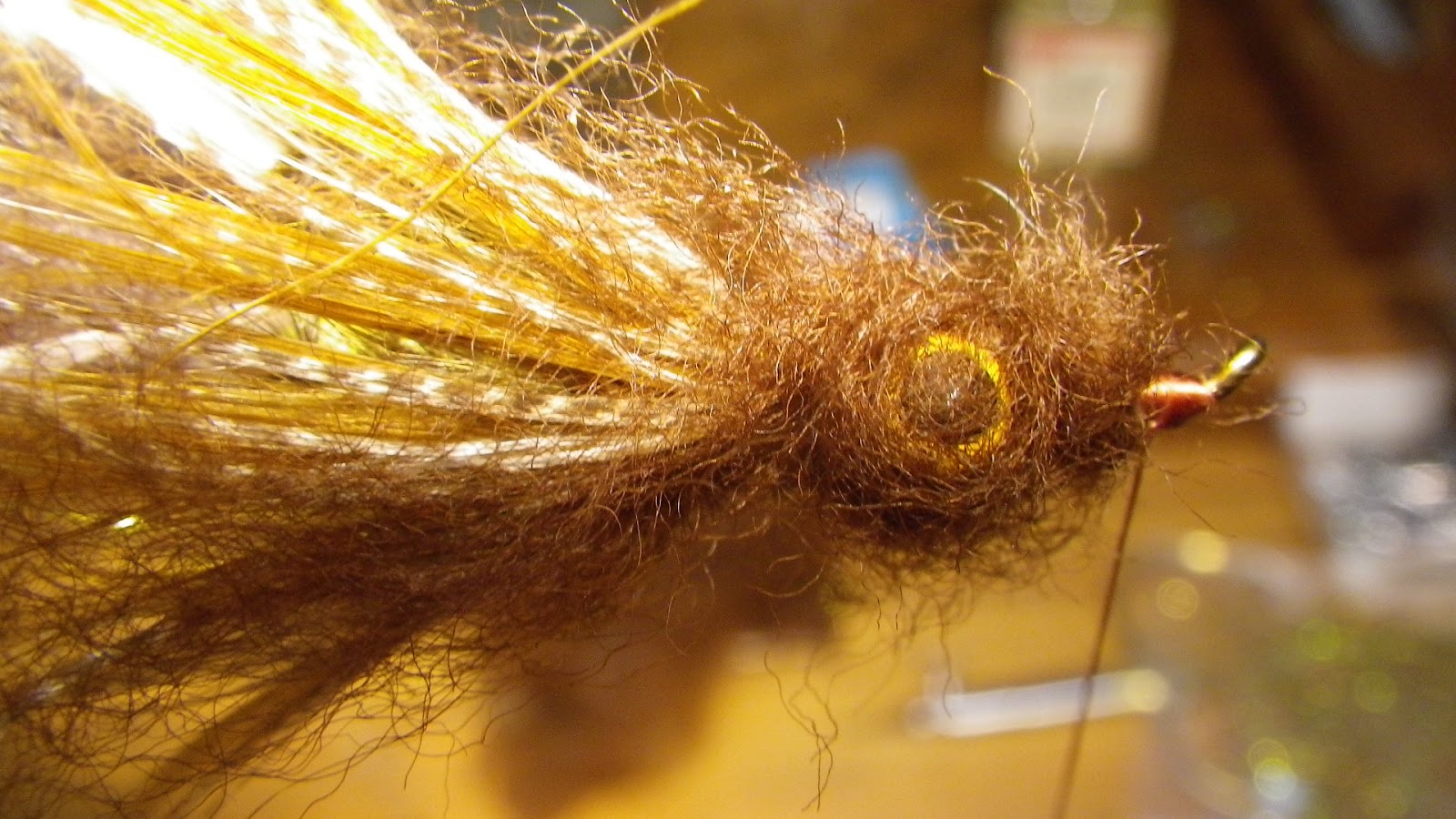
What I like about this one is that it sinks fast, is pretty tough, and it seems to capture the true nature of gobies, which are brown and olive with a yellow sheen. Enough flash to make it stand out, but they are not a shiny pretty fish. The materials capture the profile pretty well, I must say, to the point where I am so expecting a bidding war between Orvis and Umpqua Feather Merchants.
BTW, this fly grew out of a dozen really awful prototypes that were nightmares. One looked like a bluefish had chewed on it, another like it had ingested large quantities of tritium. The marabou tail version looked like a goby with a missing tail, and the deer hair head version was such a pain to get right that you wanted to go over and toilet paper Chris Helm's yard for making you think that you too could tie like he does. Because it is an impressionistic fly, it's official name is the go-again goby, after that famous impressionist painter Paul Gauguin. If you ever get a chance to see his work at the Met in NYC, go. You will be a better person. And the prototype fly will be gifted to the person who can give the correct literary attribution on how Gauguin became known as "that go-again fellow".
Friday, January 11, 2013
I'm not the NRA
I warned you. There might be political posts. This blog is primarily about fly fishing, and I do a hunting story every once in a while. I am departing from that policy this time to comment on what I believe is either a case of mass insanity, or recognition that we live in a society filled with several million sociopaths who lack any empathy. I am talking about Newtown, CT, and the incident where a crazy asshole massacred 26 children and teachers with a .223 Bushmaster assault rifle and the pathetic debate about assault rifles. I have been following the aftermath of this, and I have been carefully reading a lot of internet comments on the news stories as well as opinions in the hunting mags. Any asshole can post a comment on anything, and all of them did. Ninety percent of the comments seem to be coming from the 4 million NRA members who seem to have learned nothing from this.
But before we get into that, have been around firearms since age 6, hunt over 30 days a year, and my gun collection is bigger than yours. My first memory is holding a flintlock, one of my earliest is holding up a pheasant as my Grandfather dressed it. I have a gunsmith bench, and recently did some trigger jobs, scope mounting, and stock refinishing. There is a reloading press, two boresighters, a Tipton gun vise (deluxe model), and the shelves sag with the weight of ammo, scope rings, spare parts, magazines, choke tubes, tooling, tru-oil, lubricants, primers, solvents, components, scopes, slings and swivels, muzzleloading junk, bore snakes, cleaning rods and jags, and even a big box of kosher salt mixed with borax for drying hides of stuff I shoot. Most recent resident was a red squirrel who zigged when he should have zagged and is now the source of fur for nymphs and crayfish patterns. On the other end of the shop is a bookcase loaded with, you guessed it, books about guns, hunting, trapping, reloading, and all that stuff. I have a concealed weapons permit and I favor Smith and Wesson J frames (five for sure). I like shooting pistols and can handle the sting of a .357 magnum snub-nosed revolver. There are ballistics calculators on my computer. The next big project is to build a Pennsylvania long rifle (flintlock, of course) and not from those panty-waist kits they sell at "Track of the Wolf". So I would claim that by anyone's standards I know guns, and I am into guns more than most people I know.
I want all assault rifles banned. Not just a wimpy "let's not sell any more" but a real ban that gets all of them off the streets forever. This could take the form of "turn them in by April 15", a buyback program , or a tax or homeowners insurance rate that makes them a headache to own.
Why? Because they are designed the military for one purpose- to kill large numbers of people quickly and efficiently. The assault rifle gave the infantry soldier more firepower, that was the point. The little .223 was designed to function smoothly in a semi-auto or automatic weapon, and the smaller cartridge size meant that soldiers could carry more rounds with a lighter rifle to boot. And this is the problem.
Mass shooters simply do not pick up Browning BAR's (a semi-automatic hunting rifle with a small capacity magazine), Winchester model 94's ( a classic lever action that has killed more deer than any other rifle), Winchester pre-1964 model 70's (a bolt action, there is a consensus that those built prior to 1964 were the about the best hunting rifle ever), or even Smith and Wesson model 29's (Clint Eastwood's Dirty Harry .44 magnum, a revolver). Those guns do not have enough firepower to give them the sense of empowerment they need to carry out the act. You have to reload too often, it takes time, and people can run away by the time you have refilled the magazine or cylinder. Or maybe even get to their gun and shoot back. Invariably, mass shooters choose assault rifles or semi-automatic handguns. Both these weapons have detachable magazines that can be replaced quickly, and some rifles have magazines that can hold 30 rounds (BTW the military M-16 originally had a 20 round capacity). In Aurora, CO the shooter had a an aftermarket drum magazine that held 100 rounds. At VA tech, the shooter used a glock pistol, but had multiple aftermarket magazines that increased the capacity from about 9 rounds to 17 per clip. This turned his pistol into a shorter version of an assault rifle, albeit with less measured firepower (most pistol cartridges have less velocity and energy than most rifle cartridges). Alas, it was still enough to set a record for most people killed. The firepower/empowerment issue is the reason why mass shooters can do what they do, and it needs to be fixed.
I am glaringly unpursuaded by any of the arguments I have seen repeated ad nauseum again during the past few weeks. To whit:
If guns are outlawed, only outlaws will have guns. Maybe, but you can make them much harder to get so that these incidents will become less common. All laws are broken by some people, the idea is that law and consequences are a deterrent to crime. The implied idea is that because someone somewhere will go on a rampage with an illegal gun we can't try and reduce the odds by passing any laws because it would not be perfect. This is stupid. The argument could be applied to the existence of any law, but it is only applied to firearms. In the case of Newtown, Adam Lanza's mother was the law abiding citizen who was the actual gun owner. Being armed did not help her, and the outlaw shot the "armed good guy" in her sleep and headed off with more firepower than an entire company of civil war soldiers. And no one is really talking about a gun ban. The discussion is about assault rifles.
The constitution guarantees us the right to bear arms. Yes, it does. I won't argue that. But does it guarantee that you can own whatever arm you want whenever you want it? If this is the case, we would be allowed to have private ownership of B-52's, rocket propelled grenades, Ricin and botulism capsules, and dynamite ought to be available by the register at the hardware store. There is a ton of stuff that private citizens can not acquire because it is too dangerous to have around. We simply are adding assault rifles to the list. And we should. It is a simple public health and safety issue. Even Justice Scalia opined that the second amendment does not guarantee every type of weapon. And do note that the second amendment frames the right in the context of "well regulated militias". The NRA conveniently leaves this part out of their banners. If you are going to be champion of cause, why would you hide part of the language? I know, I know, the supreme court had a couple cases on this. But it makes me think that people are trying to pull a fast one.
This is just the first step on a slippery slope that will lead to confiscation of all our guns. This is largely due to a case of mass paranoia induced by the now-crazy NRA. The NRA actually supported certain gun restrictions in the past. After the mayhem of the 1920's machine guns were regulated highly, and after the Kennedy assassination you could no longer buy mail order rifles. The NRA supported both rules, especially the mail order ban.The present argument is a winner for them because it induces fear, because it is impossible to prove that you are not out to get them. I used to work with a miserable person who did not like to work, and who was compelled to punish our employer for some perceived wrongful act. Whenever he got an assignment (you will work with this group to do that task), he would state emphatically that "they are out to get me". He would then behave badly, act in disruptive ways, and not get any assignment done. When called out on it, his response was invariably, "see, they were out to get me". This is one of the most ingenious strategies ever because, although wrong, it completely reframes the argument away from what the NRA does not want to talk about.
The assault rifle is an essential part of hunting and shooting. Yeah, right. Only a small percentage of hunters hunt with these things, and you will never convince me that they are needed. Show me one type of hunting that requires a high capacity semi-automatic rifle because that many shots are required to harvest game or control nuisance animals. They are used for varmint hunting out west where people shoot lots of prairie dogs and ground squirrels in a single outing, but it isn't like the varmints are going to mass together and gnaw out your eyeballs like that pack of cute little dinos in the Jurassic Park sequel unless you can blast them en masse without reloading. Your .223 ammunition can be used in bolt action guns, I own one and it is more accurate than most semi-autos. There are also a couple of competitions that use them, alas, those guys will have to find a different competition to compete in. Blame it on me.
As an aside, there was this fantastic hunting show on the outdoor channel just last week about how important it was to have "modern semi-automatic rifles" (read assault rifles) for hunting exotic sheep in Texas. The argument seemed to be "this modern semi-auto rifle has been used for several years and why it looks like new" while "this classic bolt action sure shows some signs of wear and tear". And then they both mug the camera as if to show the Colt company that they did their part. There may be a logical fallacy here but the most valuable rifles I have ever seen at auction were the beat-to-shit field pieces carried by people like Teddy Roosevelt, Bell of Africa, and other notable folks. Wear and tear is normal unless you are the type of guy that keeps everything in the gun room and never ventures outside. They are not, and will never be essential for any of the shooting sports.
I need it for home defense. Dude, if you need that much firepower you need to rethink 1) your lifestyle, and 2) what really works. If you are stuck in a bad number 1 situation, go to the gun shop and buy a remington 870 12 gauge pump. You can buy 4 for the current price of an assault rifle. Fill it with turkey loads that have an ounce or more of number 6 shot. Then go to the local humane society and get a pit bull puppy. There are thousands languishing there. The dog provides an early warning system that is way better than any electronic stuff you can buy, and the sight of a pit bull looking out the window combined with the distinctive sound of a shell being racked into an 870 chamber will make even the most raving lunatic pee in their pants. This is sort of an absurd argument, but there are loads of alternatives to the assault rifle that do not provide the sense of empowerment to lunatics. And if you did need to fire, you can take down a barn with one of those things.
The assault rifle is the only thing that stands between the citizens and the tyranny of government. Bullshit. There are 10.3 million deer hunters in the U.S. There are 1.4 million people in the military. Do the math. In the event of a tyranny imposed by a dictator, about 1 in 7 deer hunters would have to fire once. And can just hear all the NRA members screaming "but some deer hunters are also in the military so you are wrong!". OK, but you get the picture and we can count upland hunters, waterfowlers, varmint hunters, elk hunters, bighorn sheep hunters, raccoon hunters, bear hunters, moose hunters, pick a species. Oh, target shooters too. I win. Assault rifles are not the last bastion protecting our democracy.
There are a zillion other arguments out there, but these were the most common. There were also some rather amusing exchanges that were too good not to report:
"They can't take away my guns because I bought them at gun shows and they can't be traced". This was posted on the internet right next to his name and email address.
"I am worried about an assault weapons ban, but what pisses me off more is the NRA calling me 3 or 4 times a week and demanding money. All they do is try and scare the shit out of people". Overheard at a gun shop of all places.
"I could put a machine gun on this counter, and it could sit there for 20 years and as long as some lunatic didn't grab it it would be completely harmless and hurt no one". Overheard at gun shop. My point exactly.
"I can reload my lever action or pump gun faster than anyone can shoot with an assault rifle" (internet post implying that assault rifles are no different than other guns). If this were true, why is the U.S. military not equipping our armed forces with lever actions and classic double barrel shotguns? There are some pump guns used in warfare but nearly all soldiers are issued assault rifles and most training is devoted to those. Verfied this via a marine who just graduated from basic.
I have heard some good proposals and would like to share some analysis of them.
1. Gun buybacks.
These are useful, but not in the way you would expect. Most of the firearms turned in in these things are antique, obsolete, or junkers that are as likely to explode in your hand as they are to fire a round. This will not reduce mass shootings because people generally do not turn in large numbers of Glocks and Bushmasters. But they do remove weapons from the households of people who are completely unfamiliar with them. It does promote public safety, especially for children who might find them. Of course, I got an email praising a sidebar "we pay cash" buyback that was competing with the cops who were offering measly gift cards for guns. They were buying assault rifles for resale. The sender thought this was American Free enterprise at its finest.
2. Education
One friend suggested that everyone who wants to own guns should be required to take a class about safety, insurance, liability, etc. He claims that once people realized the depth of responsibility fewer would want to own guns. I like this and would add that you would have to pass a marksmanship test. Most people can't shoot worth shit, and that would reduce their presence as well.
3. Rebranding Assault rifles
One post urged everyone to start referring to their black rifles as "modern semi-automatic rifles". The claim was that, technically, an assault rifle had full-auto capability so the civilian semi-auto versions were not assault rifles, really. And rebranding would make the libtards less afraid of them. I agree, and the new term for these things will be "tiny penis rifles". I can see the ad campaign now. BTW, any TV or Radio personality or comic may use this joke free of charge although it may go on facebook later tonight.
4. It is the magazine, and not the gun
This actually might work. If magazines were restricted to 5 rounds, it would reduce the empowerment somewhat and give at least a few people a fighting chance to get away. Of course this would only work if people got rid of all existing high capacity mags, but you could not really make a straight-faced claim that your right to bear arms is being buggered. Better yet, it might be possible to alter the receivers on assault rifles so the mag was no longer detachable and they could only be loaded from top. This would be an inconvenience but nothing more. And anyone who brings up the issue of "destroying the look of a fine AR-15 by altering the upper, shut the fuck up. They are hideous and even fans of them admit they are ugly as sin.
5. Armed security
I want teachers teaching, and not focused on where the gun is. Armed and trained cops in every school would work. Since the NRA is one of the primary reasons that weapons sales are going through the roof, they will pay for it. We can also dump an excise tax on all unmodified assault rifles to help make up any shortfalls. Someone estimated the cost of this as close to 1 billion dollars, so NRA members should expect 5 to 6 phone calls a week from Homeland Security asking for donations. Maybe every day.
6. Sell off your assault rifles
This is happening and it is weird. Assault rifle sales are to the point where many gun shops are sold out with none to be had. What isn't talked about is a massive increase in the number of these things being sold as within-state private sales (perfectly legal). You would think that everyone would be hanging on to these things for dear life and burying them in the backyard pursuant to President Obama's putative big gun grab, but there are a crapload of them for sale in Michigan as we speak. I guess that the sanctity of the second amendment isn't as high as we thought, as long as buyers pay double or triple.
7. Better mental health care
This is what the libtards have been calling for for years, but the same legislators loved by the NRA are the same bunch that tends to vote against any tax dollars for anything other than military spending. Note that as part of the mental health upgrade we need a huge public awareness program about groups that induce paranoia and its societal effects. I think that Obamacare would cover this, but oh. We hate that too.
8. Reduce military spending
If guns were taken away, it would be done by the military. But the NRA supports (generally) republicans who vote for a strong military, who are the people that would take away their guns. Still trying to figure that one out. Refer to idea 7.
9. Marksmanship classes in high school
This a truly good idea. I used to work at the rifle range at a boy scout camp, and the troops were pretty boisterous right up until the minute the senior instructor fired a wimpy .22 long rifle into a ripe tomato as a demonstration of what would happen to your head if you were shot. After that they got attentive and serious, and we never had a serious safety incident. It would be fun and might get them off the couch and away from mindless videos. I do not see the connection between violence and videos, but I do see a connection with lack of reading. It would teach a useful skill, safety, and would be a good dose of reality about guns. And I have to admit, I can't count the number of times that journalists with no knowledge of firearms make factual mistakes in their reporting about guns. Most are de minimus, but the gun rights crowd seizes on this as proof positive that the gun regulations crowd is just plain stupid. And some are.
10. Refuse to have sex with anyone who owns an assault rifle until they turn it in to the local police station.
Problem solved within the first week.
So far, the NRA has won this hands down. They know that they can keep most people too afraid to have the discussion, and that in a month or two everyone will focus on the next distraction and the problem will fade into memory except for coverage of the one year anniversary. This is the way it is. Four million people can make enough noise so that the other 306 million of us can live with fear and dread.
I used to dislike the NRA because I am a hunter. Their litmus test for political support was a public proclamation of gun rights, and it did not matter if the candidate was also selling off state game lands to loggers, trying to turn national forests in a playground for mining, attempting to gutting environmental regulations that made game and fish safe to eat, and favoring energy policies that destroy habitat. As long as they supported gun rights anything else was OK. They co-opted almost every outdoor sporting organization so those groups spend ten times as much time talking about gun rights as they do habitat. But this latest go-round has pissed me off royally. Somewhere, out there, I want someone to know that hunters and gun owners are not all alike, and some of us care about what happened. I own only one or two guns that might be subject to regulation (semi-auto .22's) but I would give them up in a heartbeat if I thought that it would reduce the chance of ever having to hear about Aurora, Newtown, or Virginia Tech again. We owe those people a voice. Theirs was taken from them by bad public policy dictated by the NRA. And anyone who believes that their their second amendment rights to own assault weapons is more important than the first amendment rights of defenseless first graders (the life part of life, liberty, and pursuit of happiness) is a sociopath. OK, that last part was stolen from a facebook friend who is a far better writer than I will ever be.
The irony in all this is that had the NRA issued a press release offering sorrow and condolence, and said something to the effect of "we will have a discussion about gun issues, but not now out of repect for the lost children and their families" they might have had to endure background checks at gun shows, limits on magazine capacity, and maybe a wimpy assault weapons ban. Probably a lot like the last ban that really did not do much and wasn't enforced much anyway. Instead, they came out with both guns blazing and missed with all 36 shots (Glocks, extended magazine plus one in the chamber). Now, there are millions of people who would support taking their guns simply because they now think that all NRA members are a bunch of assholes and deserve whatever happens. And the subsequent internet comments have been like adding gas to an open flame.
I have no illusions. Few people read this blog, and I expect maybe three or four comments, most of which will be of the "filthy liberal scum" variety. I am one, but with guns. So save your breath. I doubt this blog will have a profound influence on public policy. In the end, if there is a gun ban, the NRA will have probably done it to themselves.
But before we get into that, have been around firearms since age 6, hunt over 30 days a year, and my gun collection is bigger than yours. My first memory is holding a flintlock, one of my earliest is holding up a pheasant as my Grandfather dressed it. I have a gunsmith bench, and recently did some trigger jobs, scope mounting, and stock refinishing. There is a reloading press, two boresighters, a Tipton gun vise (deluxe model), and the shelves sag with the weight of ammo, scope rings, spare parts, magazines, choke tubes, tooling, tru-oil, lubricants, primers, solvents, components, scopes, slings and swivels, muzzleloading junk, bore snakes, cleaning rods and jags, and even a big box of kosher salt mixed with borax for drying hides of stuff I shoot. Most recent resident was a red squirrel who zigged when he should have zagged and is now the source of fur for nymphs and crayfish patterns. On the other end of the shop is a bookcase loaded with, you guessed it, books about guns, hunting, trapping, reloading, and all that stuff. I have a concealed weapons permit and I favor Smith and Wesson J frames (five for sure). I like shooting pistols and can handle the sting of a .357 magnum snub-nosed revolver. There are ballistics calculators on my computer. The next big project is to build a Pennsylvania long rifle (flintlock, of course) and not from those panty-waist kits they sell at "Track of the Wolf". So I would claim that by anyone's standards I know guns, and I am into guns more than most people I know.
I want all assault rifles banned. Not just a wimpy "let's not sell any more" but a real ban that gets all of them off the streets forever. This could take the form of "turn them in by April 15", a buyback program , or a tax or homeowners insurance rate that makes them a headache to own.
Why? Because they are designed the military for one purpose- to kill large numbers of people quickly and efficiently. The assault rifle gave the infantry soldier more firepower, that was the point. The little .223 was designed to function smoothly in a semi-auto or automatic weapon, and the smaller cartridge size meant that soldiers could carry more rounds with a lighter rifle to boot. And this is the problem.
Mass shooters simply do not pick up Browning BAR's (a semi-automatic hunting rifle with a small capacity magazine), Winchester model 94's ( a classic lever action that has killed more deer than any other rifle), Winchester pre-1964 model 70's (a bolt action, there is a consensus that those built prior to 1964 were the about the best hunting rifle ever), or even Smith and Wesson model 29's (Clint Eastwood's Dirty Harry .44 magnum, a revolver). Those guns do not have enough firepower to give them the sense of empowerment they need to carry out the act. You have to reload too often, it takes time, and people can run away by the time you have refilled the magazine or cylinder. Or maybe even get to their gun and shoot back. Invariably, mass shooters choose assault rifles or semi-automatic handguns. Both these weapons have detachable magazines that can be replaced quickly, and some rifles have magazines that can hold 30 rounds (BTW the military M-16 originally had a 20 round capacity). In Aurora, CO the shooter had a an aftermarket drum magazine that held 100 rounds. At VA tech, the shooter used a glock pistol, but had multiple aftermarket magazines that increased the capacity from about 9 rounds to 17 per clip. This turned his pistol into a shorter version of an assault rifle, albeit with less measured firepower (most pistol cartridges have less velocity and energy than most rifle cartridges). Alas, it was still enough to set a record for most people killed. The firepower/empowerment issue is the reason why mass shooters can do what they do, and it needs to be fixed.
I am glaringly unpursuaded by any of the arguments I have seen repeated ad nauseum again during the past few weeks. To whit:
If guns are outlawed, only outlaws will have guns. Maybe, but you can make them much harder to get so that these incidents will become less common. All laws are broken by some people, the idea is that law and consequences are a deterrent to crime. The implied idea is that because someone somewhere will go on a rampage with an illegal gun we can't try and reduce the odds by passing any laws because it would not be perfect. This is stupid. The argument could be applied to the existence of any law, but it is only applied to firearms. In the case of Newtown, Adam Lanza's mother was the law abiding citizen who was the actual gun owner. Being armed did not help her, and the outlaw shot the "armed good guy" in her sleep and headed off with more firepower than an entire company of civil war soldiers. And no one is really talking about a gun ban. The discussion is about assault rifles.
The constitution guarantees us the right to bear arms. Yes, it does. I won't argue that. But does it guarantee that you can own whatever arm you want whenever you want it? If this is the case, we would be allowed to have private ownership of B-52's, rocket propelled grenades, Ricin and botulism capsules, and dynamite ought to be available by the register at the hardware store. There is a ton of stuff that private citizens can not acquire because it is too dangerous to have around. We simply are adding assault rifles to the list. And we should. It is a simple public health and safety issue. Even Justice Scalia opined that the second amendment does not guarantee every type of weapon. And do note that the second amendment frames the right in the context of "well regulated militias". The NRA conveniently leaves this part out of their banners. If you are going to be champion of cause, why would you hide part of the language? I know, I know, the supreme court had a couple cases on this. But it makes me think that people are trying to pull a fast one.
This is just the first step on a slippery slope that will lead to confiscation of all our guns. This is largely due to a case of mass paranoia induced by the now-crazy NRA. The NRA actually supported certain gun restrictions in the past. After the mayhem of the 1920's machine guns were regulated highly, and after the Kennedy assassination you could no longer buy mail order rifles. The NRA supported both rules, especially the mail order ban.The present argument is a winner for them because it induces fear, because it is impossible to prove that you are not out to get them. I used to work with a miserable person who did not like to work, and who was compelled to punish our employer for some perceived wrongful act. Whenever he got an assignment (you will work with this group to do that task), he would state emphatically that "they are out to get me". He would then behave badly, act in disruptive ways, and not get any assignment done. When called out on it, his response was invariably, "see, they were out to get me". This is one of the most ingenious strategies ever because, although wrong, it completely reframes the argument away from what the NRA does not want to talk about.
The assault rifle is an essential part of hunting and shooting. Yeah, right. Only a small percentage of hunters hunt with these things, and you will never convince me that they are needed. Show me one type of hunting that requires a high capacity semi-automatic rifle because that many shots are required to harvest game or control nuisance animals. They are used for varmint hunting out west where people shoot lots of prairie dogs and ground squirrels in a single outing, but it isn't like the varmints are going to mass together and gnaw out your eyeballs like that pack of cute little dinos in the Jurassic Park sequel unless you can blast them en masse without reloading. Your .223 ammunition can be used in bolt action guns, I own one and it is more accurate than most semi-autos. There are also a couple of competitions that use them, alas, those guys will have to find a different competition to compete in. Blame it on me.
As an aside, there was this fantastic hunting show on the outdoor channel just last week about how important it was to have "modern semi-automatic rifles" (read assault rifles) for hunting exotic sheep in Texas. The argument seemed to be "this modern semi-auto rifle has been used for several years and why it looks like new" while "this classic bolt action sure shows some signs of wear and tear". And then they both mug the camera as if to show the Colt company that they did their part. There may be a logical fallacy here but the most valuable rifles I have ever seen at auction were the beat-to-shit field pieces carried by people like Teddy Roosevelt, Bell of Africa, and other notable folks. Wear and tear is normal unless you are the type of guy that keeps everything in the gun room and never ventures outside. They are not, and will never be essential for any of the shooting sports.
I need it for home defense. Dude, if you need that much firepower you need to rethink 1) your lifestyle, and 2) what really works. If you are stuck in a bad number 1 situation, go to the gun shop and buy a remington 870 12 gauge pump. You can buy 4 for the current price of an assault rifle. Fill it with turkey loads that have an ounce or more of number 6 shot. Then go to the local humane society and get a pit bull puppy. There are thousands languishing there. The dog provides an early warning system that is way better than any electronic stuff you can buy, and the sight of a pit bull looking out the window combined with the distinctive sound of a shell being racked into an 870 chamber will make even the most raving lunatic pee in their pants. This is sort of an absurd argument, but there are loads of alternatives to the assault rifle that do not provide the sense of empowerment to lunatics. And if you did need to fire, you can take down a barn with one of those things.
The assault rifle is the only thing that stands between the citizens and the tyranny of government. Bullshit. There are 10.3 million deer hunters in the U.S. There are 1.4 million people in the military. Do the math. In the event of a tyranny imposed by a dictator, about 1 in 7 deer hunters would have to fire once. And can just hear all the NRA members screaming "but some deer hunters are also in the military so you are wrong!". OK, but you get the picture and we can count upland hunters, waterfowlers, varmint hunters, elk hunters, bighorn sheep hunters, raccoon hunters, bear hunters, moose hunters, pick a species. Oh, target shooters too. I win. Assault rifles are not the last bastion protecting our democracy.
There are a zillion other arguments out there, but these were the most common. There were also some rather amusing exchanges that were too good not to report:
"They can't take away my guns because I bought them at gun shows and they can't be traced". This was posted on the internet right next to his name and email address.
"I am worried about an assault weapons ban, but what pisses me off more is the NRA calling me 3 or 4 times a week and demanding money. All they do is try and scare the shit out of people". Overheard at a gun shop of all places.
"I could put a machine gun on this counter, and it could sit there for 20 years and as long as some lunatic didn't grab it it would be completely harmless and hurt no one". Overheard at gun shop. My point exactly.
"I can reload my lever action or pump gun faster than anyone can shoot with an assault rifle" (internet post implying that assault rifles are no different than other guns). If this were true, why is the U.S. military not equipping our armed forces with lever actions and classic double barrel shotguns? There are some pump guns used in warfare but nearly all soldiers are issued assault rifles and most training is devoted to those. Verfied this via a marine who just graduated from basic.
I have heard some good proposals and would like to share some analysis of them.
1. Gun buybacks.
These are useful, but not in the way you would expect. Most of the firearms turned in in these things are antique, obsolete, or junkers that are as likely to explode in your hand as they are to fire a round. This will not reduce mass shootings because people generally do not turn in large numbers of Glocks and Bushmasters. But they do remove weapons from the households of people who are completely unfamiliar with them. It does promote public safety, especially for children who might find them. Of course, I got an email praising a sidebar "we pay cash" buyback that was competing with the cops who were offering measly gift cards for guns. They were buying assault rifles for resale. The sender thought this was American Free enterprise at its finest.
2. Education
One friend suggested that everyone who wants to own guns should be required to take a class about safety, insurance, liability, etc. He claims that once people realized the depth of responsibility fewer would want to own guns. I like this and would add that you would have to pass a marksmanship test. Most people can't shoot worth shit, and that would reduce their presence as well.
3. Rebranding Assault rifles
One post urged everyone to start referring to their black rifles as "modern semi-automatic rifles". The claim was that, technically, an assault rifle had full-auto capability so the civilian semi-auto versions were not assault rifles, really. And rebranding would make the libtards less afraid of them. I agree, and the new term for these things will be "tiny penis rifles". I can see the ad campaign now. BTW, any TV or Radio personality or comic may use this joke free of charge although it may go on facebook later tonight.
4. It is the magazine, and not the gun
This actually might work. If magazines were restricted to 5 rounds, it would reduce the empowerment somewhat and give at least a few people a fighting chance to get away. Of course this would only work if people got rid of all existing high capacity mags, but you could not really make a straight-faced claim that your right to bear arms is being buggered. Better yet, it might be possible to alter the receivers on assault rifles so the mag was no longer detachable and they could only be loaded from top. This would be an inconvenience but nothing more. And anyone who brings up the issue of "destroying the look of a fine AR-15 by altering the upper, shut the fuck up. They are hideous and even fans of them admit they are ugly as sin.
5. Armed security
I want teachers teaching, and not focused on where the gun is. Armed and trained cops in every school would work. Since the NRA is one of the primary reasons that weapons sales are going through the roof, they will pay for it. We can also dump an excise tax on all unmodified assault rifles to help make up any shortfalls. Someone estimated the cost of this as close to 1 billion dollars, so NRA members should expect 5 to 6 phone calls a week from Homeland Security asking for donations. Maybe every day.
6. Sell off your assault rifles
This is happening and it is weird. Assault rifle sales are to the point where many gun shops are sold out with none to be had. What isn't talked about is a massive increase in the number of these things being sold as within-state private sales (perfectly legal). You would think that everyone would be hanging on to these things for dear life and burying them in the backyard pursuant to President Obama's putative big gun grab, but there are a crapload of them for sale in Michigan as we speak. I guess that the sanctity of the second amendment isn't as high as we thought, as long as buyers pay double or triple.
7. Better mental health care
This is what the libtards have been calling for for years, but the same legislators loved by the NRA are the same bunch that tends to vote against any tax dollars for anything other than military spending. Note that as part of the mental health upgrade we need a huge public awareness program about groups that induce paranoia and its societal effects. I think that Obamacare would cover this, but oh. We hate that too.
8. Reduce military spending
If guns were taken away, it would be done by the military. But the NRA supports (generally) republicans who vote for a strong military, who are the people that would take away their guns. Still trying to figure that one out. Refer to idea 7.
9. Marksmanship classes in high school
This a truly good idea. I used to work at the rifle range at a boy scout camp, and the troops were pretty boisterous right up until the minute the senior instructor fired a wimpy .22 long rifle into a ripe tomato as a demonstration of what would happen to your head if you were shot. After that they got attentive and serious, and we never had a serious safety incident. It would be fun and might get them off the couch and away from mindless videos. I do not see the connection between violence and videos, but I do see a connection with lack of reading. It would teach a useful skill, safety, and would be a good dose of reality about guns. And I have to admit, I can't count the number of times that journalists with no knowledge of firearms make factual mistakes in their reporting about guns. Most are de minimus, but the gun rights crowd seizes on this as proof positive that the gun regulations crowd is just plain stupid. And some are.
10. Refuse to have sex with anyone who owns an assault rifle until they turn it in to the local police station.
Problem solved within the first week.
So far, the NRA has won this hands down. They know that they can keep most people too afraid to have the discussion, and that in a month or two everyone will focus on the next distraction and the problem will fade into memory except for coverage of the one year anniversary. This is the way it is. Four million people can make enough noise so that the other 306 million of us can live with fear and dread.
I used to dislike the NRA because I am a hunter. Their litmus test for political support was a public proclamation of gun rights, and it did not matter if the candidate was also selling off state game lands to loggers, trying to turn national forests in a playground for mining, attempting to gutting environmental regulations that made game and fish safe to eat, and favoring energy policies that destroy habitat. As long as they supported gun rights anything else was OK. They co-opted almost every outdoor sporting organization so those groups spend ten times as much time talking about gun rights as they do habitat. But this latest go-round has pissed me off royally. Somewhere, out there, I want someone to know that hunters and gun owners are not all alike, and some of us care about what happened. I own only one or two guns that might be subject to regulation (semi-auto .22's) but I would give them up in a heartbeat if I thought that it would reduce the chance of ever having to hear about Aurora, Newtown, or Virginia Tech again. We owe those people a voice. Theirs was taken from them by bad public policy dictated by the NRA. And anyone who believes that their their second amendment rights to own assault weapons is more important than the first amendment rights of defenseless first graders (the life part of life, liberty, and pursuit of happiness) is a sociopath. OK, that last part was stolen from a facebook friend who is a far better writer than I will ever be.
The irony in all this is that had the NRA issued a press release offering sorrow and condolence, and said something to the effect of "we will have a discussion about gun issues, but not now out of repect for the lost children and their families" they might have had to endure background checks at gun shows, limits on magazine capacity, and maybe a wimpy assault weapons ban. Probably a lot like the last ban that really did not do much and wasn't enforced much anyway. Instead, they came out with both guns blazing and missed with all 36 shots (Glocks, extended magazine plus one in the chamber). Now, there are millions of people who would support taking their guns simply because they now think that all NRA members are a bunch of assholes and deserve whatever happens. And the subsequent internet comments have been like adding gas to an open flame.
I have no illusions. Few people read this blog, and I expect maybe three or four comments, most of which will be of the "filthy liberal scum" variety. I am one, but with guns. So save your breath. I doubt this blog will have a profound influence on public policy. In the end, if there is a gun ban, the NRA will have probably done it to themselves.
Sunday, January 6, 2013
The original and sadly forgotten sucker spawn fly pattern
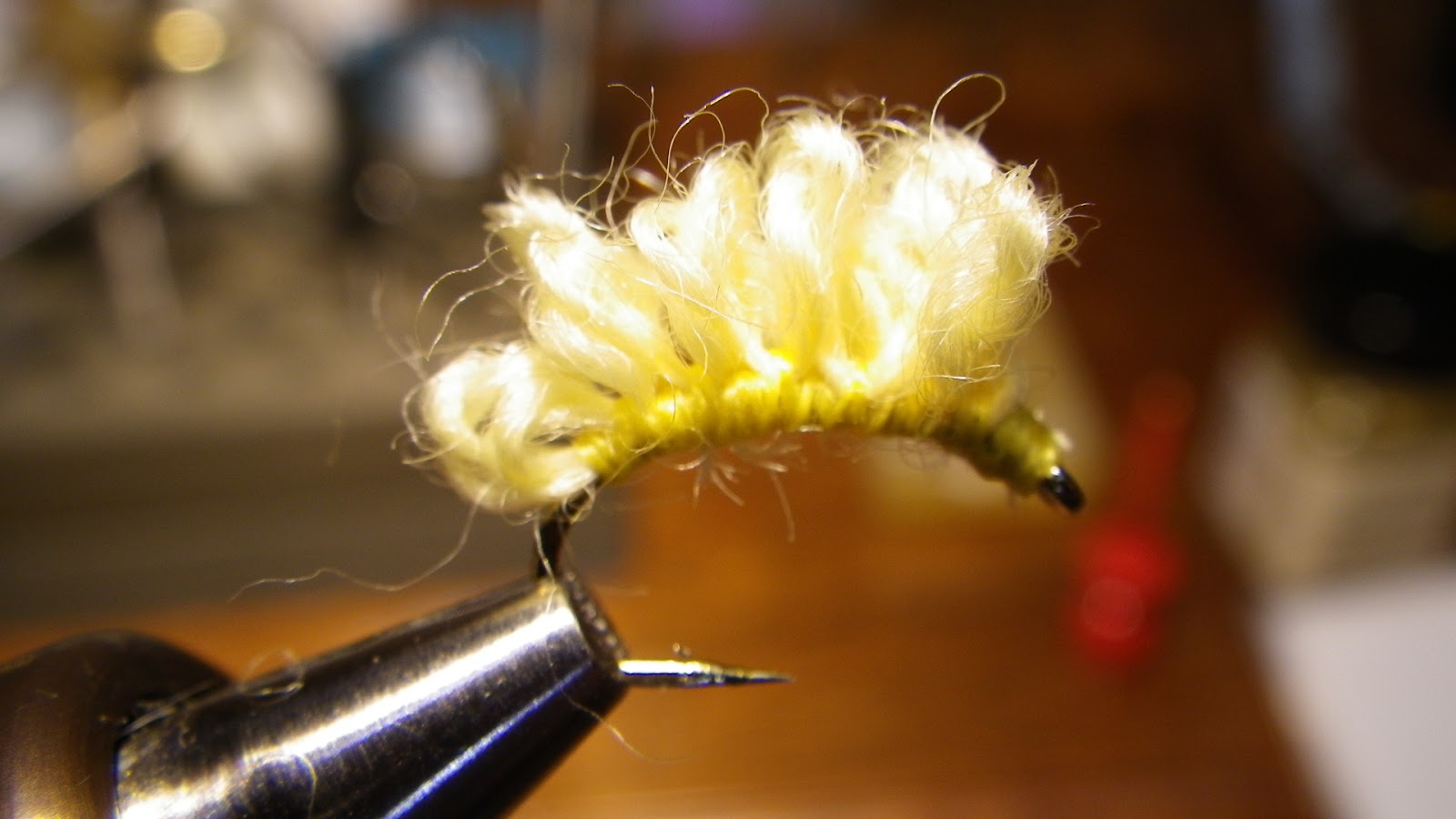
The sucker spawn is a fly pattern well known to steelhead anglers. It's tied in a myriad of colors and materials, including one variation called "the crystal meth" that uses diamond braid. BTW, I am getting rather perturbed by the new trend in fly patterns that seems to require obscene or coarse names for otherwise beautiful flies. But enough of that.
The sucker spawn is well known to anyone who fishes steelhead, especially those who fish steelhead alley in Ohio. For those of you who do not know about this, ODNR manages many Lake Erie tributaries for steelhead. Smolts are stocked in the rivers, and they emigrate to Lake Erie's cold eastern basin for a year or two, then return to spawn. To my knowledge there is no natural spawning, but fish hang in the rivers much of the winter and they eat flies well, probably because there isn't that much natural insect life compared to their native habitats. The Erie tribs have a reputation for producing double digit numbers of smallish fish (2-5 lb) but every time I fish there I get my clock cleaned by a Chinook-sized steelhead at least once per day.
The sucker spawn is a consistent producer because, lo and behold, it looks like a skein of sucker eggs! But if you ask most people they view it as a modern steelhead pattern that originated in the midwest. Not true, it was a trout fly that came from Pennsylvania and was in use by the 1970's. I became acquainted with it in 1973 when a childhood friend took me fishing on the flies-only stretch of the Tulpehocken River in Berks County, PA. It was the trout opener. He gave me two flies, and we caught so many fish that several gentlemen demanded to see our terminal rigs to verify that we were not using bait. Now, these were stocked trout, but I have used the pattern off and on in other trout streams with great success over the years.
I had wondered about the origins of the pattern for years, but recently Lefty Kreh mentioned that he was shown the pattern in Pennsylvania about 40 years ago (an online article about six flies to carry at all times). And he mentioned the original color (cream) which is consistent with what I was given. So the pattern really started as a trout fly in eastern PA, and only later became a steelhead fly. Here is the recipe and tying instructions:
Materials: two pieces of cream colored wool yarn about 5 inches long. Tying thread. The original used white or cream. The example in the photo is yellow Danville flat waxed nylon. I have no idea what the wool was but it was pretty coarse. Makes for a rough looking fly, but who cares? The fish eat it. I like a big meaty size ten, Lefty Kreh mentions sizes 12-16 as his preferred hook sizes.
Instructions: Cover the hook shank with thread. If using a modern curved shank hook, bring the thread well back. Tie in two pieces of yarn. Form small loops with both, lash down with two wraps, then secure with two wraps right in front of the loops you just created. Keep marching up the hook shank with double loops until you reach the eye, then whip finish. The secret is to use two pieces of yarn which makes the tying go fast and easy. I don't think that the yarn material matters, but color does. I still prefer cream after all these years, although blaze orange (Bernat acrylic yarn color 00615) is a killer on steelhead. The acrylics do give you neater loops as well and you can also use teased out egg yarn. . Always have a couple of cream sucker spawns somewhere in the box. I like them best on misty days when the water has a slight stain.
Thursday, December 6, 2012
The double strike indicator
A while back I wrote about the steelhead style indicator and it's superiority to all other strike indicators. This is still true, but there is another strategy that you can use. This one is a pain to prepare, but absolutely effective and amusing to boot. It is the double strike indicator, and uses two indicators placed strategically on the leader to detect the most subtle takes.
1.Get a package of those Rio Kahuna indicators. This is essentially a blaze orange section of fly line. Break off two pieces, each about 1/2 to 3/4 of an inch long. Snap them off with your fingers, and do not cut them to length because they have a mono core that must be pulled out to create a hollow tube so you can thread them on the leader.
2. Get a 9 foot tapered leader. For trout, I like Orvis super-strong leaders, for bass and salt I like the Scientific anglers bonefish ones. Although any tapered leader will work.
3. Thread both indicators on the leader. For trout tippets this will be easy, but for thicker tippets you may need to carefully thread them on to a needle. The hollow core is teeny ...After you get them on slide them up to the butt so they are out of the way.
4. Cut the leader about 4 or 5 feet down from the butt end, and tie it back together with a blood knot. Slide the first indicator down to the knot which will hold it in place.
5. Cut the leader again about 2 feet below the butt, knot it back together, and slide the second indicator down to the knot. You now have a ruined tapered leader with two indicators about 2 or 3 feet apart.
The fun comes in fishing this rig, and it is a hoot. What you are doing is watching not only the movement of the lower indicator, but the relative position between them. Any time the distance between them or their relative position changes, it is likely a fish. One of my favorites is when the lower one starts moving upstream while the upper continues down. There are all sorts of crazy ways to detect fish, and it is surprising how many takes you perceive that would be missed with a single indicator near the leader butt. So you have to buy indicators, and it sort of trashes a perfectly good knotless leader, but the education and fun are worth it. Try one sometime.
1.Get a package of those Rio Kahuna indicators. This is essentially a blaze orange section of fly line. Break off two pieces, each about 1/2 to 3/4 of an inch long. Snap them off with your fingers, and do not cut them to length because they have a mono core that must be pulled out to create a hollow tube so you can thread them on the leader.
2. Get a 9 foot tapered leader. For trout, I like Orvis super-strong leaders, for bass and salt I like the Scientific anglers bonefish ones. Although any tapered leader will work.
3. Thread both indicators on the leader. For trout tippets this will be easy, but for thicker tippets you may need to carefully thread them on to a needle. The hollow core is teeny ...After you get them on slide them up to the butt so they are out of the way.
4. Cut the leader about 4 or 5 feet down from the butt end, and tie it back together with a blood knot. Slide the first indicator down to the knot which will hold it in place.
5. Cut the leader again about 2 feet below the butt, knot it back together, and slide the second indicator down to the knot. You now have a ruined tapered leader with two indicators about 2 or 3 feet apart.
The fun comes in fishing this rig, and it is a hoot. What you are doing is watching not only the movement of the lower indicator, but the relative position between them. Any time the distance between them or their relative position changes, it is likely a fish. One of my favorites is when the lower one starts moving upstream while the upper continues down. There are all sorts of crazy ways to detect fish, and it is surprising how many takes you perceive that would be missed with a single indicator near the leader butt. So you have to buy indicators, and it sort of trashes a perfectly good knotless leader, but the education and fun are worth it. Try one sometime.
Monday, November 5, 2012
Tampa Bay redfish
The blog has been pretty quiet for some time because a) readers can only take so many smallmouth stories, and b) some people have to work for a living and can't fly fish every day. Last week found me within spitting distance of Tampa Bay, and a block of time with no appointments, talks, workshops, meetings, socials, fundraisers, or other jiggery-pokery. Mostly because of a mis-communication with the ticket booking that got me there a day early, and on a Sunday. Nothing left to do but fish.
This was exciting because I had lived in Tampa a while back, and had taken up saltwater fly fishing during the last year I lived there. It was fun, but I sucked at it. Could not double haul, did not know the right flies or techniques, and never had much time anyway. So I had never caught a redfish. I did a google search and found my old friend Leigh, and he graciously set up a trip for us to wade some flats. After a breakfast of begnettes and other cajun stuff we headed out. I won't talk about the spot or the techniques we used (it was a popular place mentioned in guidebooks and we threw clousers). Although I learned a great deal, that was not what struck me.
First, Tampa Bay sits smack in the middle of one of the most urbanized areas of Florida, and what lies just inside most of the shoreline with high density development and lots of concrete. Back in the day I recall many areas with sparse seagrass and a lot of mud. That is no longer the case. We fished on seagrass flats that were lush and green over sandy bottom that did not pull off my "one size too large but that was all they had" flats boots. Mangroves grew in profusion along the shoreline, and there were thousands of birds ranging from a loggerhead shrike to roseate spoonbills. A manatee swam by. Minnows by the millions swarmed at low tide and predators crashed them right in front of us. Tampa is doing something right, and they should be commended for their efforts. Environmental regulations and environmental restoration work. A lot of it is due to the efforts of Tampa Baywatch. Send them money, or if you live there volunteer for some of their many hands-on projects. And also Florida anglers, who increasingly practice catch and release.
The other thing is that Tampa Bay has one of the coolest fisheries ever because you never really know what is going to eat your fly. My friend Leigh outfished me with reds, seatrout, hardhead catfish, ladyfish, and a snook. I was king of the flounder, but also ladyfish and my first redfish ever on a fly. It was probably best described as a little rat red, but I thought it was glorious and darn near the prettiest fish ever caught in the ocean. We also saw some bluefish crashing bait, and many other species are possible (although some are seasonal). And unlike the keys where flats fishing gets tough during the winter and you need a boat, Tampa Bay has year round wade fishing with many easy public access points. I even started thinking that the traffic wasn't so bad after all, and the real estate was rather attractively priced. If they had deer hunting close by I would retire there tomorrow. And may think about it anyway because I know of few other places where you can target that many species depending on your mood that day.
Tampa Bay is better than ever, and if you are ever within striking distance you would be a fool not to try it.
This was exciting because I had lived in Tampa a while back, and had taken up saltwater fly fishing during the last year I lived there. It was fun, but I sucked at it. Could not double haul, did not know the right flies or techniques, and never had much time anyway. So I had never caught a redfish. I did a google search and found my old friend Leigh, and he graciously set up a trip for us to wade some flats. After a breakfast of begnettes and other cajun stuff we headed out. I won't talk about the spot or the techniques we used (it was a popular place mentioned in guidebooks and we threw clousers). Although I learned a great deal, that was not what struck me.
First, Tampa Bay sits smack in the middle of one of the most urbanized areas of Florida, and what lies just inside most of the shoreline with high density development and lots of concrete. Back in the day I recall many areas with sparse seagrass and a lot of mud. That is no longer the case. We fished on seagrass flats that were lush and green over sandy bottom that did not pull off my "one size too large but that was all they had" flats boots. Mangroves grew in profusion along the shoreline, and there were thousands of birds ranging from a loggerhead shrike to roseate spoonbills. A manatee swam by. Minnows by the millions swarmed at low tide and predators crashed them right in front of us. Tampa is doing something right, and they should be commended for their efforts. Environmental regulations and environmental restoration work. A lot of it is due to the efforts of Tampa Baywatch. Send them money, or if you live there volunteer for some of their many hands-on projects. And also Florida anglers, who increasingly practice catch and release.
The other thing is that Tampa Bay has one of the coolest fisheries ever because you never really know what is going to eat your fly. My friend Leigh outfished me with reds, seatrout, hardhead catfish, ladyfish, and a snook. I was king of the flounder, but also ladyfish and my first redfish ever on a fly. It was probably best described as a little rat red, but I thought it was glorious and darn near the prettiest fish ever caught in the ocean. We also saw some bluefish crashing bait, and many other species are possible (although some are seasonal). And unlike the keys where flats fishing gets tough during the winter and you need a boat, Tampa Bay has year round wade fishing with many easy public access points. I even started thinking that the traffic wasn't so bad after all, and the real estate was rather attractively priced. If they had deer hunting close by I would retire there tomorrow. And may think about it anyway because I know of few other places where you can target that many species depending on your mood that day.
Tampa Bay is better than ever, and if you are ever within striking distance you would be a fool not to try it.
Thursday, July 26, 2012
The Forgotten 7 weight

Of all the fly rods sold in the U.S., fewer 7 weights are purchased than any other. Think about this- fewer 7 weights sold than 11 or 12 weight tarpon rods? Ridiculous, but I have heard this three distinct times from people who are very knowledgable in the fly fishing business. This is a shame, because you are missing out on one of the perfect line sizes for freshwater fishing, and here is why.
The 7 weight is an oddball, but its oddity is that it sits right in the sweet spot that is the compromise between finesse weights and the big dogs. I want to explain why, but first you have to understand line weights.
Back in the day, manufacturers had no standards for fly lines, and each brand was a bit different. They also had labels that were weird letter designations. A was the heaviest, and G and H were fine. A double taper line might have a GCG designations, while a heavy weight forward might have GBH. No one could understand it, and it got to be a problem once glass fly rods became common and everyone could fly fish. The manufacturers standardized lines in the 1970's to the numerical system used today that includes line type (DT or WF), a line weight based on weight in grains of the first 30 feet, and an F or S designation for floating or sinking. It is still in use.
The problem is that most anglers think that, because the line numbers are classed arithmetically, the line weights are as well. They are not. Look at the curve above, and you will see my point. From 3 to 6 weights, line weight does increase in a straight line with 20 grain increments. A 3 weight weighs 100 grains, a 4 weight 120, with a six weight topping out at 160. Jumping to 7 and 8 weights line weight increases by 25 grain increments, and each line weight after than has an even larger progression in terms of adding more weight.
The bottom line is that 7 weights sit right on the inflection point of the curve, and are the heaviest line weight you can get just before things really start to get heavy. To me, they are the heaviest line weight that one can cast all day, and they are the perfect size for casting large dries and big weighted streamers. An 8 weight will handle the big stuff even better, but there is no finesse and try casting one all day. They are a great western trout rod, especially when the wind comes up, and you can cast into the mangroves with streamers all day without your arm falling off. Eight weights and above are nearly always designed for fighting large fish, but that comes with extra weight that does not translate into lightness in the hand.
Another problem with 7 weights is that they really need to be designed like saltwater rods. I see quite a few with wee little cigar grips or the like, and you really need a full wells grip and two stripping guides for them to reach their full potential. That is a rod you can root around with in Tampa Bay, but it can fish large dries quite effectively. The same thing is true for steelheading where you can expect big fish, but only if you do a couple hundred perfect drifts for hours at a time. I use a 10 foot 7 weight, and wish I had one six inches longer. I think that enough poorly furnished rods are out there such that anglers got spooked years ago and no longer long for them.
I use 7 weights for a lot of fishing, and it is my freshwater go to line size just about any time I am not fishing dry flies for snooty trout and for those guys I am usually fishing much shorter cane rods. They are much more versatile than you think, and ideal for any freshwater situation that requires all day casting with medium or large flies. For smallmouth, they are perfect.
Tuesday, July 24, 2012
A cure for the summer doldrums

Sort of lapse for the past few weeks, for one simple reason: it has been hot as hell here in Michigan. We have shattered multiple daily highs (this has gotten monotonous) as well as several never been hotter at this place ever records. No rain for 6 weeks, and I have been watering yard trees to keep them alive.
This has had an insane effect on Michigan Rivers. Ultra low water, hardly any flows, and the quiet stretches have become so weed-filled that fishing is more like gardening. You hook a fish, it dives into the salad, and you wade over to clear the morass of junk on the leader and are rewarded by a green fish on the other end of the tippet. Surprisingly, water temps are warm but not like you would think because most of our rivers get some groundwater. Anyway, people do not like to read about skunk trips and a couple in a row were close. We were in the doldrums, and I was starting to dream of September and salmon.
But ...
Last weekend we found a river. A little one that was like fishing two rivers at once. The upstream portion was small and tight, and so shaded that it was cool and dark. But downstream, it made a sudden transition into a mile wide and an inch deep with all the salad fixings. The water was so low and clear that I decided to fish upstream. This turned out to be an eye opener. Mind you, smallmouth bass on the fly is not a finesse sport. Trout fishing is figure skating, smallmouth fishing is roller derby. You fling big flies, and it does not matter if you are six inches from the big rock or 6 feet because the next cast will be closer and the sloppy cast is likely to catch a fish anyway. Down and across, move down, repeat until satiated or you have just enough energy to slog back up to the access. But in a tiny stream this was an anathema. The first few casts ended up in trees until I remembered how to actually cast. I then moved along quietly, and put a small white bluegill popper close to any cover I could find. A limb sticking out from the bank, a tiny knee deep cut in an ankle-deep run, a weird deep pool the size of a bathtub that was almost isolated from all flow by the low water. Most casts were less than 30 feet, and many placed the fly in the water on the opposite side of dry exposed ground.
I took a tip from my friend Ron. He likes to fish slowly to the point where he often lags behind us as we run and gun. My approach is that if they do not want it in two or three casts then the hell with them and I will go find someone who does. He moseys along, and just keeps putting in front of them until they all decide that this must be a bugger hatch and commence feeding. Earlier that day we watched him snake half a dozen fish out of a hole that everyone else considered fishless, so I decided that this was an interesting trick and tried to emulate his approach.
I floated the popper past each cover at least 20 times, and every damned time fish would start to whack it on the 10th or 15th float. But only if it was fished on a dragless float with teeny twitches that moved the rubber legs but made no real noise. I tried a couple of pops, and constant movement but never got a hit that way. It was dead drift with a twitch or two or nothing (there is an earlier post about this technique). This was a small stream, and I expected rock bass with the occasional 6 to 10 inch fish, but was surprised by both the number and size of the smallmouth lurking in the reach. And how they could still be invisible in a foot of water. A couple of 10-12 inches, then a couple that you had to grab by the lip to land. Go figure. It was an amazing day that was more like dry fly fishing for trout, and after a while I realized that the number of fish was up there to a point where there were some bragging rights to be claimed.
This is where it gets weird. I began to wonder what had happened to my friends who had disappeared downstream, and got to the point where I thought I had better find them. I expected them to be back at the car with heat stroke, but nothing doing. So I went downstream for a big garden fest. I expected nothing because the habitat was barren, it was now hitting 90 degrees, brilliant sunshine, and they had already fished through not an hour before. Came to a place that looked like it might be worth a cast. A trench had formed along the bank, and it was at least knee deep with the rest of the river channel being barely over your boot soles. Better yet, the afternoon sun was low enough to cast a shadow line that put it in the dark. Popper goes out, and what followed was strange to say the least. There was a hit on every cast for 30 minutes, I never moved, and every fish came from an area the size of a pool table. No master angler fish, but no dinks, and the largest fish was an honest 15 inches (measured). It was as if the entire bass population of the watershed decided to gather for mass suicide. The catch rate was governed entirely by how fast you could land them on a 3x tippet and get them unhooked and back in the water. At some point, you no longer wanted or needed to catch another fish, but you had to keep fishing just to see how long this could possibly go on. It finally slowed down, but moving downstream still produced fish until I met my partners on their way back up. I asked them if they had fished that run and they had, but it only produced a few dinks because at that point it was still in the sun. Even weirder, I was darned glad I was fishing a 7 weight. Fish were fighting hard, and there was more leaping that I had seen in quite some time.Actually, one hell of a lot of leaping. I have no idea of the final tally of fish released, but it was large enough that I actually considered staying home the following weekend to paint exterior door trims. At least for a couple of minutes.
A new river, a new technique, and it was glorious. One of the best things about fly fishing is that rare moment when you just can't explain anything and simply have to accept that something worked. And the doldrums were cured. Especially after the previous trip the night beforethat ended with no fish and being lost in a buckthorn thicket while wearing shorts.
More about 7 weights next time, and why you should fish them more often than you do.And I am working on a salmon primer for those who must.
Saturday, June 16, 2012
Yet another one fly disaster
I have to stop entering these things. They end quickly, and they end badly. For readers not familiar with the concept, one-flies are tournaments run for charity, and each angler gets one fly, and on fly only. Not one pattern, but one fly. If it goes in a tree, falls apart, or has the hook break on a bad backcast that ticks a rock, you are done. The object is to get the most points before something bad happens, and you get points by catching fish, with bigger fish usually worth more.
This one was organized by Schultz outfitters in Ypsilanti, MI as a benefit for the Huron River watershed council (HWRC). This is one of the most progressive watershed councils in the Nation, and they do things that range from stonefly searches (stones are good environmental indicators) to helping the cities of the watershed adapt to climate change. They have real scientists and everything.
So we went to a fun party, and got up next morning to win, and win big. My fishing partner was my wife, and we had long discussions about strategy. We decided that since we were a team, I would go low and slow with an indestructible kevlar tied crayfish pattern, and she would go on top with a surface fly- a gartside gurgler. After mayhem, photographs, and getting acquainted with some new Huron River anglers, we set off bound for glory. I decided to fish in downtown Ypsilanti, where we used to joke that there was bass under every shopping cart. In part thanks to HRWC this is no longer the case, at least the shopping cart part.
Fishing sucked, at least where we were. First spot produced one rock bass and teeny tiny long release smallmouth. Departed for greener pastures at a honey hole that had given up, on average, a dozen prize winning bass each trip every time I had fished there. This was not to be the case that day, and after an hour and a half I was surprised by a single 9 inch bass that was a full inch above the minimum size for entry.. Feeling good about not finishing dead last, I worked down to the first deep run of the morning (the water was record low and pretty clear) and dead drifted Mr. indestructible crayfish down a slot. The line stopped, and I thought I was snagged up until the snag tried to jump and throw the fly. Not a 20 incher, but big enough so that when he jumped he could not get completely out of the water. Two runs, got him on the reel, and then of all things, the line goes slack. I reel in only to find a flyless leader with the telltale curlicue of a knot that has pulled free. I was done. I thought back to that knot, and had stopped mid-tie when someone asked me a question. The improved clinch knot turned out to be only a clinch, and a bad one at that.
I was disheartened and had to think hard about the real purpose of the day which was to benefit the river. HWRC is unusual in that they are an "environmental" group that interacts successfully with anglers. Very few environmental groups get along well with the "hook and bullet" crowd, but everyone I know loves them. That is saying something. Despondent, I reviewed the rules that allowed teams to share rods. I made my wife give me her rod and fly, and proceeded to be vindicated with a 12 incher, thereby securing me another step up from dead last. However, she figured out my strategy quickly and I was called out. We gave it our best shot, and after an hour in the 90 degree plus sunshine with only rare and desultory nosing of the topwater flies it boiled down to two choices: 1) drive 20 miles upriver to really good spot where they were sure to be biting and have a shot at placing, or 2) go to an air conditioned bar within sight of the fly shop HQ just down the street. Bar won, unanimous decision achieved in seconds.
Just wait until next year.
This one was organized by Schultz outfitters in Ypsilanti, MI as a benefit for the Huron River watershed council (HWRC). This is one of the most progressive watershed councils in the Nation, and they do things that range from stonefly searches (stones are good environmental indicators) to helping the cities of the watershed adapt to climate change. They have real scientists and everything.
So we went to a fun party, and got up next morning to win, and win big. My fishing partner was my wife, and we had long discussions about strategy. We decided that since we were a team, I would go low and slow with an indestructible kevlar tied crayfish pattern, and she would go on top with a surface fly- a gartside gurgler. After mayhem, photographs, and getting acquainted with some new Huron River anglers, we set off bound for glory. I decided to fish in downtown Ypsilanti, where we used to joke that there was bass under every shopping cart. In part thanks to HRWC this is no longer the case, at least the shopping cart part.
Fishing sucked, at least where we were. First spot produced one rock bass and teeny tiny long release smallmouth. Departed for greener pastures at a honey hole that had given up, on average, a dozen prize winning bass each trip every time I had fished there. This was not to be the case that day, and after an hour and a half I was surprised by a single 9 inch bass that was a full inch above the minimum size for entry.. Feeling good about not finishing dead last, I worked down to the first deep run of the morning (the water was record low and pretty clear) and dead drifted Mr. indestructible crayfish down a slot. The line stopped, and I thought I was snagged up until the snag tried to jump and throw the fly. Not a 20 incher, but big enough so that when he jumped he could not get completely out of the water. Two runs, got him on the reel, and then of all things, the line goes slack. I reel in only to find a flyless leader with the telltale curlicue of a knot that has pulled free. I was done. I thought back to that knot, and had stopped mid-tie when someone asked me a question. The improved clinch knot turned out to be only a clinch, and a bad one at that.
I was disheartened and had to think hard about the real purpose of the day which was to benefit the river. HWRC is unusual in that they are an "environmental" group that interacts successfully with anglers. Very few environmental groups get along well with the "hook and bullet" crowd, but everyone I know loves them. That is saying something. Despondent, I reviewed the rules that allowed teams to share rods. I made my wife give me her rod and fly, and proceeded to be vindicated with a 12 incher, thereby securing me another step up from dead last. However, she figured out my strategy quickly and I was called out. We gave it our best shot, and after an hour in the 90 degree plus sunshine with only rare and desultory nosing of the topwater flies it boiled down to two choices: 1) drive 20 miles upriver to really good spot where they were sure to be biting and have a shot at placing, or 2) go to an air conditioned bar within sight of the fly shop HQ just down the street. Bar won, unanimous decision achieved in seconds.
Just wait until next year.
Sunday, June 10, 2012
Mr. Gar says "hello!"

We need a break from fly fishing. This week's trip was canned at noon due to unseasonable heat and malaise, and it wasn't worth talking about.
I once collected a gar for an ichthyology class, and the preservation went bad, except for the head which got sort of mummified. This became "Mr. Gar" and he became a family tradition. Mr. Gar had a knack for showing up anywhere and everywhere: my mom's floral centerpieces during formal dinners for stodgy relatives, looking out of the ice ring in the punch bowl, as a Christmas ornament, and even a wedding cake where his little jaws embraced the bride. That appearance didn't last long, but he was moved to a place of honor looking out over the crowd from a champagne glass placed on the bridal party table. My favorite part of this was that my mom became wise to his appearances, and would try to find him before her dinners. But he always found a way to join the party. When my mom would spy him peaking out of the flowers, we kids would all shout in unision "Mr. Gar says Hello"! She would get royally pissed off at us, which was the main point. However, she changed her mind and started including him in the arrangements herself, and would usually place him looking out at whatever family member had given her a hard time recently. Let this record reflect that his wasn't ALWAYS pointed at me. Over the years, Mr. Gar became part of the family, and was included in many venues. He would travel to reunions, weddings and the like ensconced in his own travel box, or later hanging from the rear view mirror in a fine Christmas ribbon, shown above. Once he was lost for over a year, and everyone felt sad until he was rediscovered hiding among the christmas ornaments.
Mr. Gar has appeared at four weddings (OK, like only two were mine): Two marriages ended in divorce, the others are happy. The unhappy marriages were typified by horrified reactions to Mr. Gar, subsequent banishment, and forcing him to live in a box in the basement. The happy ones occurred when the new spouse greeted Mr. Gar with affection and subsequently included him in family gatherings. I have long thought about the divination powers of Mr. Gar, and have considered renting him out to recently engaged individuals who have secret reservations about their husband/wife to be. But to exploit such a noble species for profit would be wrong. And if word got out, a serious trade in gar could ensue and contribute to their decline.
Mr. gar is quite worn, and had a bad encounter with the little Hiatus (the rat terrier puppy introduced in an older post) but I have such respect for gars I have been reluctant to kill another. He is, however, somewhat worse for the wear as is any object smaller than a bus that has spent more than five minutes alone with a rat
Saturday, June 2, 2012
Carl Hansen and the glass minnow
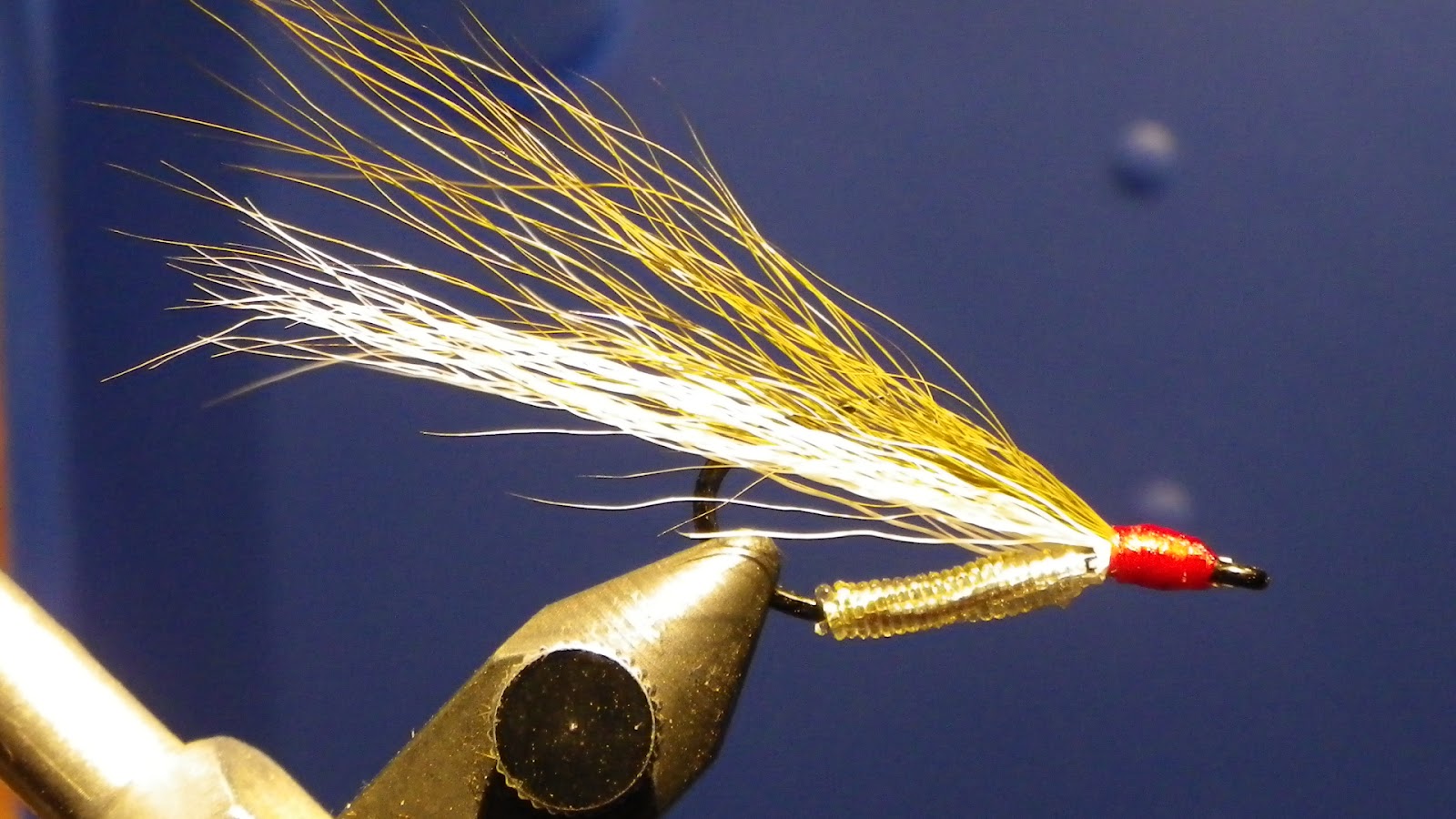
Carl Hansen was a fly angler from St. Petersburg, FL. He is known nationally as the inventor of the glass minnow pattern. Carl fished the saltwater flats near Tampa Bay, and had a unique approach. Envision a Tampa Bay fly fishing club outing. O dark thirty, and about 50 guys with the latest incarnation of graphite rods, Abel reels galore, and flats boats warming up at the launch ramp. Everyone up the night before tying the latest trendy fly patterns. Madness and mayhem as everyone headed out to be the first one on "big snook flat" or wherever they thought they needed to go given the tide, temperature, barometer, season, and latest guide reports.
Carl would sit there at the picnic area, wait for the sun to come up so he could tie up a few bend back glass minnows. Aluminum foil, mono overwrap for the bodies, a bit of bucktail, and red thread for the heads. No cement, a cheap vise that probably came from Herters in 1955, and I think he did own one pair of sewing scissors. He would then string up a 7 foot cane rod (a three weight, no less) with a reel that I believe was made in 1917- the year may not be right but it was given to him as a kid and he was about 80 years old when I knew him.
He would then wade out in front of the picnic tables up to his knees, and no deeper. He would then cast back to shore. Although he could cast like no one else, most of his casts might be 30 feet. Each cast would last a couple minutes and he would move the fly continuously in little twitches or with a hand twist retrieve. In 2 or 3 hours he might move 30 feet. About noon, all the young guns would come flying back to the launch ramp for the picnic, and you know how this ends. Carl would have caught more fish than the rest of the club combined. His explanation was simple: his fly was in the water, and the glass minnow moves exactly like a real baitfish. Predators move, so most of the snook, seatrout, and redfish in Tampa Bay would pass by him at some point in the morning, and would encounter a fly that looked and moved naturally that was actually in the water when they cruised by.
Carl was an amazing guy- he and his wife Esther had a casting clinic that met once a week at their house for over 30 years, and historians will correct me that its tenure may have been much longer. He did get some recognition of his skills, and was often asked to tie flies at Florida heritage festivals. He could put a fly in a teacup at 30 feet every time you asked him to do it. No BS, every time, and none of this false casting to get the distance right. And this was not hyperbole. The club had casting contests, one of which was a teacup at 30 feet. I saw it. He fished until the very end of his life, and when the end came he went out like the man he was. He told his family and friends that he did not want a funeral. He said that anyone who gave a damn about him should take a child fishing.
The glass minnow:
Use a pliers to bend a hook bendback style. Most people bend it too far. Don't.
Wrap a bit of foil around the hook shank below the bend.
Take a piece of 8 to 12 lb. mono, and wrap it over itself using a snell knot. It takes some practice, but you will end up with shiny foil body protected by mono wraps.
Tie in a sparse bucktail wing. I think that white over greenish blue was Carl's favorite, but he also felt that any color would work. It has to be sparse. Carl would have corrected my wing as resembling a feather duster.
That is it.
Fish the fly over any seagrass bed, bottom discontinuity, or structure. Move it slowly so it crawls along through the water column just above the grass. Expect the unexpected.
Carl would sit there at the picnic area, wait for the sun to come up so he could tie up a few bend back glass minnows. Aluminum foil, mono overwrap for the bodies, a bit of bucktail, and red thread for the heads. No cement, a cheap vise that probably came from Herters in 1955, and I think he did own one pair of sewing scissors. He would then string up a 7 foot cane rod (a three weight, no less) with a reel that I believe was made in 1917- the year may not be right but it was given to him as a kid and he was about 80 years old when I knew him.
He would then wade out in front of the picnic tables up to his knees, and no deeper. He would then cast back to shore. Although he could cast like no one else, most of his casts might be 30 feet. Each cast would last a couple minutes and he would move the fly continuously in little twitches or with a hand twist retrieve. In 2 or 3 hours he might move 30 feet. About noon, all the young guns would come flying back to the launch ramp for the picnic, and you know how this ends. Carl would have caught more fish than the rest of the club combined. His explanation was simple: his fly was in the water, and the glass minnow moves exactly like a real baitfish. Predators move, so most of the snook, seatrout, and redfish in Tampa Bay would pass by him at some point in the morning, and would encounter a fly that looked and moved naturally that was actually in the water when they cruised by.
Carl was an amazing guy- he and his wife Esther had a casting clinic that met once a week at their house for over 30 years, and historians will correct me that its tenure may have been much longer. He did get some recognition of his skills, and was often asked to tie flies at Florida heritage festivals. He could put a fly in a teacup at 30 feet every time you asked him to do it. No BS, every time, and none of this false casting to get the distance right. And this was not hyperbole. The club had casting contests, one of which was a teacup at 30 feet. I saw it. He fished until the very end of his life, and when the end came he went out like the man he was. He told his family and friends that he did not want a funeral. He said that anyone who gave a damn about him should take a child fishing.
The glass minnow:
Use a pliers to bend a hook bendback style. Most people bend it too far. Don't.
Wrap a bit of foil around the hook shank below the bend.
Take a piece of 8 to 12 lb. mono, and wrap it over itself using a snell knot. It takes some practice, but you will end up with shiny foil body protected by mono wraps.
Tie in a sparse bucktail wing. I think that white over greenish blue was Carl's favorite, but he also felt that any color would work. It has to be sparse. Carl would have corrected my wing as resembling a feather duster.
That is it.
Fish the fly over any seagrass bed, bottom discontinuity, or structure. Move it slowly so it crawls along through the water column just above the grass. Expect the unexpected.
Monday, May 28, 2012
Rocket Bass

Most of my readers (that number being 3) have figured out that I spend most of my time chasing smallmouth bass. Well, if you live in SE Michigan and do not feel like driving 3.5 hours for trout, that is what you do. We here in MI catch a lot of rock bass while pursuing smallmouths, and most anglers view them as one step up from a speeding ticket. They inhale flies so you have to stop fishing and pull out the hemostats, they give a might tug like a trophy smallmouth then roll over and play dead, and they are of a size that you can't grab them by the lower jaw. This results in at least one really good fin-prick every trip. They are despised and "don't count" for many anglers.
Everyone is wrong. Rock bass are cool. They give novice partners great practice at fishing cover (where you always find them), they cooperate during fly fishing clinics when the bass are thumbing their noses at you, and they create positive memories of otherwise sparse days. They tend to lie doggo in very specific spots, so when you get on to them it is a great chance to tell you buddies that you had a 50 fish day. I once caught over 30 from a single backwater the size of a pool table, and stopped only when it got so repetitive that I had to move on, having punished the species enough for one day.
The rock bass also provided me with one of my coolest experiences ever. I was casting a small popper, and hooked a good-sized one that would have been an absolute keeper for any panfish angler. When I got it within 10 feet of the rod tip, the line just sort of stopped and thought that it had darted under a log or something. Instead, the "snag" started circling and I spotted the largest smallmouth I have ever seen, ever. It had inhaled the rock bass completely (did I mention that this was a good sized rock bass) and we were at a standoff. The bass would not let go, but I could not hook the bass because the popper was, of course, deep within the jaws of Mr. rocket bass and the hook wasn't exposed. This went on for quite some time. Every once in a while the bass would lose the rock bass only to grab it again. The smallmouth finally got bored with this and sort of lumbered off to the trench. This occurred on a river where an 18 inch smallmouth gives you bragging rights for weeks, and 20 inchers are an urban legend. This fish was 25 inches at least, and probably weighed over 6 pounds. Only a bass that size could inhale a 6 inch rock bass repeatedly and make it look easy each time I saw it happen. I did release the rock bass, but it was not a happy rock bass and probably spent the rest of the summer growing new scales.
The rock bass in the photo above was caught last week, and until I got it to hand I thought it was a decent smallmouth. About 12 inches, and twice the size of the usual "nice rock bass" you hold up for your fishing partner to admire. Of course, no tape measure so a chance at a Michigan master angler rock bass certificate was lost. It made me cry inside. Note to self, add tape measure to gear list, and also pick up one of those cutesy Simms fish counter things that you always thought were stupid until you realized that no will believe the abundance of this species until you have some real numbers.
Saturday, May 26, 2012
Lake Huron Bassin'

It is just like fishing the flats in Florida or the bahamas, except there are no stingrays to puncture your feet, no sharks or stinging jellies, and if you get dehydrated you can bend over and take a drink.In some cases you can wade a mile offshore before it gets too deep to cast effectively. But knee deep is all you need.
So we showed up at a well known spot, and waded out. A fly fishing club had beaten us, and their anglers were all in a giant circle whipping a boulder field to a froth. There are three ways of fishing here: you can cast to rocks, you can cast to fish, or you can blind cast to channels and the edges of rocky bars. The rock casting approach works well, but it has the inherent problem that in nearly every case you are fishing an active spawning bed. In the Great Lakes, this is bad because studies by Jeff Steinhart of Lake Superior State University have shown that even when the bass is released, by the time it gets back to the nest the invasive round gobies have swarmed in and eaten most of the eggs or fry. So it is best to look for cruisers, or fish the edges. I have cast to fish on beds, and will fish that way if nothing else works or I have a novice partner who really needs to catch a bass. But the cruisers are actually more fun and good practice for bonefish and redfish because you are casting to a moving target. Harder than it looks.
I quickly became king of the lost fish and missed four in a row. Blind casting did nothing, and it dawned on me that every fish I had hooked was seen first, either meandering along the bars or chasing minnows up on top of them. So we formed a line and worked shallow to deep. A pod of fish swam right between us and we each got a couple before they wised up and vamoosed toward the stygian depths. This went on for a while with pods coming and going, but then it sort of died. We decided to try a different spot a couple of miles down the road.
The new place was different: smallmouths everywhere: tailing in pairs as they spawned, milling around by each rock, singles cruising in water barely deep enough to cover their dorsals. We loafed down the shoreline and came to an ancient rock spit formed by some fool who thought that stretch of the coast would make a darn good harbor. Next to it there is a deep bowl shaped depression filled with massive boulders that I call Stonehenge. Normally Stonehenge is submerged and armpit deep, but with the low water this year it barely reached your waist. There was a pod of bass sitting in the middle of the thing that had at least 100 fish. They were obviously feeding. It was one of those things that you know you are going to pay for because on some level it is morally wrong to catch that many fish. Every cast resulted in a phalanx of bass following the crayfish imitation, and one would dart forward and inhale it. I had debarbed my fly, and if one threw it on a jump another would grab it when it fell back in. The best part was when I decided to see if they would hit a streamer. Tied on a bucktail emerald shiner pattern, debarbed it, and tossed it out into the center of the bowl. I looked down and saw my hemostat sitting on top of the chest pack, so I put the rod under my arm as I stuffed it into a compartment. Looked up, and the fly was floating motionless on the surface. A fish leaped out of the water to inhale it, and that question was answered. They actually seemed to like the streamer better, if that were possible. This went on and on and on until they finally all got bored with us and left for hot sex in the shallows. I lost count of the number of fish we caught, but realized that you can't have a 50 fish day up there because it takes a long time to land 16 inch fish, and after a while your arm gets tired.
We got a couple more out deeper, but the wind got higher and there were no more big pods to be seen. We even waded out to the edge of the deep blue, but the only thing we saw were Ohio-class common carp and they were having nothing to do with the likes of us.
The epilogue is as strange as can be. I tipped a good friend who lives to fish that area. He got there 24 hours later. The winds had shifted 180 degrees to the north, and the flat was barren as my checking account the day before payday. Not a fish in site, empty beds, and I think he got one fish the entire day. I will be up there again in a few weeks. Spawning will be long over, but there will still be fish out a bit deeper, and the carp will be cruising around in huge pods. Not to mention freshwater drum and the occasional channel cat. Flats fishing at its finest, and way cheaper than a ticket to the Bahamas to fish for bunch of snooty bonefish that remind me of a marine version of the white sucker. Michigan rocks.
Wednesday, April 25, 2012
The two minute muzzleloader hunt, or an idiot takes up muzzleloading
I am the worst deer hunter in the world. There are a couple reasons for this, among which I never took it seriously. I thought that it was really about dumb luck, and not about skill. I tended to buy a license the night before, and sort of throw together some gear. This changed somewhat as I got to know skilled hunters, and I shot a few deer over the years. But never a decent buck. The one buck I took in a late season hunt was a running shot at 50 yards, and by the time he went down he had shed his antlers and there was no finding them in the deep snow.
I moved back to Michigan in 1998, and promptly shot a doe the first time out because I was hunting with my fried Mike B., who is a wildlife biologist and set up our strategy. He then moved away and I went deerless for years. Fast forward to 2010. I vowed that this would be the year, but the night before the opener my stepdaughter decided that she wanted to try deer hunting. We actually saw three, but she became frozen solid by about 1000 and that was it for the opener. I hunted pretty diligently that season but saw nothing. When it was over, I was not ready to quit, and vowed to get a muzzleloader to extend the season into December. In Michigan our firearm season is November 15-30, and muzzleloader starts on December 2 and runs almost to Christmas.
The 2011 opener was the antithesis of my prior hunting. I had gotten to know Dave D., and he is one of the best hunters I know. He can find game anywhere and anytime he hunts and became my guide. I had a tack driving shotgun, excellent gear, and I had learned how to pick a stand that deer liked, and not one that I liked. And best of all, I had a muzzleloader. It was a lightly used Thompson encore that I had picked up over the summer, and it would be my fallback if the firearm season did not pan out. I even got load data and some sabots that looked like the gun should have been advertised in a field artillery forum rather than the "used guns for sale" website.
The 2011 firearm season was a bust. We hunted public land in SE Michigan. The opener had too few hunters to push deer, and fog. No one saw deer, but there was enough pressure to push them into the puckerbrush, unharvested corn on private lands, and the odd places that no one could get to without spooking them from a hundred yards out. We did stands, swamp hunts, ridge hunts, pincer movements, still hunts, and every other trick known to deer hunters to no avail. We did see one buck that jumped into the swamp rather than moving in one of the any other directions that would have offered a shot, and I missed a small buck that popped up in front of me as I was huddled in a fetal position in the rain trying to stick it out for just a few more minutes before throwing in the towel. The season ended with a whimper, and not even a sighting during the last week.
The muzzleloader season started the following Friday, and of course I was back at work trying to catch up from all the time I was not in the office. And there was another issue: despite my best intentions I had not done a thing with the muzzleloader other than go to Cabelas and have the helpful hunting guy point to stuff I needed. OK, I did have some powder charges weighed out, but had never even loaded the thing. I decided to sleep in on Saturday, but woke up at 0400 out of what had become habit. I thought about the muzzleloader sitting on the workbench and decided that it needed to be used otherwise my wife might start to question its purchase. The following timeline is true and accurate, and the events will be reported with integrity as they actually happened.
0500 decide to load the gun, and wonder how hard to actually push the sabot into the barrel. Is it all the way in? How hard are these things supposed to seat?
0600 breakfast, coffee, sloth, stumbling around trying to find gear. Take muzzleloader jiggery pokery out of shopping bag, look at it, etc.
0700 arrive at the state game lands. Note that the woods resemble a sea of blaze orange and there are more guys out with muzzleloaders than on the opening day of firearms season.
0705 Arrive at the one place where I had seen deer, only to find it filled with pickup trucks and guys with muzzleloaders.
0715 Legal shooting time begins. I am, of course, driving around aimlessly.
0730 I am still driving around looking for a pulloff that I can get the little fish car into without getting stuck in the 4 inches of new snow.
0745 Find a bare spot that I can pull into. A place I had never hunted.
0800 Finally start hunting after figuring out the primer thingy, reorganizing pack, locating accoutrements and possibles, and deciding which way to head in.
0801 Set off car alarm as I try to lock the car, letting every deer within miles know that something is up.
0802 work my way about 150 feet into the woods, get tangled in a mass of autumn olives. Really cloudy and dark, so decide to stand there for 15 minutes until it gets light enough to look for a proper stand. Only shooting lane is a narrow keyhole between two giant cedars down at the edge of a wooded swamp.
0802:30 Totally wishing I had not had that extra cup of coffee. Decided to wait it out a bit longer.
0803 Hear a noise, and turn to see a squirrel. Immediately notice a 6 point buck walking along the edge of the swamp behind said squirrel. Realize that buck may walk between the cedars. Gun up, hammer back, deer sashays into the dark opening about 30 yards away.
At this point, it was the strangest thing. It happened so fast that I had no chance to get buck fever. I squeezed the trigger, there was a recoil, and I see the deer go flying sideways and crumple into a heap. But there was no smoke! I thought that the primer had not ignited the charge, but there in front of me is a dead deer. I had not realized that Blackhorn 209 is a smokeless propellent.
0803:30 Violate every rule by not reloading and charging down to the now dead buck. It dawns on me that this is a nice buck, and my days of patterning my life after Escanaba in the moonlight are over. Pretty much have to sit down and stop hyperventilating for a couple minutes. A true 6 point with no brow tines and a big body. Not bad for the most heavily hunted public game land in the State of Michigan.
Tag deer, field dress deer, drag deer 75 feet to the road, and get the car which is only 100 feet further down the road. At this point it dawns on me. The little fish car is VW sportwagen with a panoramic sunroof and a teeny roof rack that can support about 150 lbs. This deer weighs more. I had honestly never considered that I would get to this point. Call wife for assistance and a big drop cloth, she is game but prefers to have nothing to do with this unless all other strategies fail. Finally realize that I can boost it in upside down with the old mouse-chewed vest put into service as a sacrificial garment to prevent leakage. Drive home in triumph, then on to deer processor. Call everyone on my cell phone, post to facebook, etc.
1200 Dogs enjoying boiled deer liver. Big mistake, they followed me around for weeks after.
In restropect, it was a strange thing. As I dragged the deer out to the road, I saw its tracks and realized that it had been probably been standing there watching me screw around for 10 minutes. It could have gone anywhere, but took a path to the one spot where I had a shot. It was dumb luck, but I did not get buck fever, remembered to cock the hammer, I followed it in the scope until it stepped into the one good place for a shot, I squeezed, and remembered to aim low. And I had put in my time and paid my dues with many hours in the field. I have decided that deer hunting is not about luck, it does require some skill, but it is really about being worthy enough to receive what is sent to you by the Great Manitou.
The venison salamis were greeted with joy at many Christmas parties, and saturday morning backstraps and eggs have become the breakfast of choice. And I find myself haunting the crossbow counter at Cabelas so I can start hunting the bow season on October 1 and not have to wait until November 15.
Time for bed, the mystery of spring turkey season starts tomorrow at 0605. I suspect it will require more than two minutes ...
I moved back to Michigan in 1998, and promptly shot a doe the first time out because I was hunting with my fried Mike B., who is a wildlife biologist and set up our strategy. He then moved away and I went deerless for years. Fast forward to 2010. I vowed that this would be the year, but the night before the opener my stepdaughter decided that she wanted to try deer hunting. We actually saw three, but she became frozen solid by about 1000 and that was it for the opener. I hunted pretty diligently that season but saw nothing. When it was over, I was not ready to quit, and vowed to get a muzzleloader to extend the season into December. In Michigan our firearm season is November 15-30, and muzzleloader starts on December 2 and runs almost to Christmas.
The 2011 opener was the antithesis of my prior hunting. I had gotten to know Dave D., and he is one of the best hunters I know. He can find game anywhere and anytime he hunts and became my guide. I had a tack driving shotgun, excellent gear, and I had learned how to pick a stand that deer liked, and not one that I liked. And best of all, I had a muzzleloader. It was a lightly used Thompson encore that I had picked up over the summer, and it would be my fallback if the firearm season did not pan out. I even got load data and some sabots that looked like the gun should have been advertised in a field artillery forum rather than the "used guns for sale" website.
The 2011 firearm season was a bust. We hunted public land in SE Michigan. The opener had too few hunters to push deer, and fog. No one saw deer, but there was enough pressure to push them into the puckerbrush, unharvested corn on private lands, and the odd places that no one could get to without spooking them from a hundred yards out. We did stands, swamp hunts, ridge hunts, pincer movements, still hunts, and every other trick known to deer hunters to no avail. We did see one buck that jumped into the swamp rather than moving in one of the any other directions that would have offered a shot, and I missed a small buck that popped up in front of me as I was huddled in a fetal position in the rain trying to stick it out for just a few more minutes before throwing in the towel. The season ended with a whimper, and not even a sighting during the last week.
The muzzleloader season started the following Friday, and of course I was back at work trying to catch up from all the time I was not in the office. And there was another issue: despite my best intentions I had not done a thing with the muzzleloader other than go to Cabelas and have the helpful hunting guy point to stuff I needed. OK, I did have some powder charges weighed out, but had never even loaded the thing. I decided to sleep in on Saturday, but woke up at 0400 out of what had become habit. I thought about the muzzleloader sitting on the workbench and decided that it needed to be used otherwise my wife might start to question its purchase. The following timeline is true and accurate, and the events will be reported with integrity as they actually happened.
0500 decide to load the gun, and wonder how hard to actually push the sabot into the barrel. Is it all the way in? How hard are these things supposed to seat?
0600 breakfast, coffee, sloth, stumbling around trying to find gear. Take muzzleloader jiggery pokery out of shopping bag, look at it, etc.
0700 arrive at the state game lands. Note that the woods resemble a sea of blaze orange and there are more guys out with muzzleloaders than on the opening day of firearms season.
0705 Arrive at the one place where I had seen deer, only to find it filled with pickup trucks and guys with muzzleloaders.
0715 Legal shooting time begins. I am, of course, driving around aimlessly.
0730 I am still driving around looking for a pulloff that I can get the little fish car into without getting stuck in the 4 inches of new snow.
0745 Find a bare spot that I can pull into. A place I had never hunted.
0800 Finally start hunting after figuring out the primer thingy, reorganizing pack, locating accoutrements and possibles, and deciding which way to head in.
0801 Set off car alarm as I try to lock the car, letting every deer within miles know that something is up.
0802 work my way about 150 feet into the woods, get tangled in a mass of autumn olives. Really cloudy and dark, so decide to stand there for 15 minutes until it gets light enough to look for a proper stand. Only shooting lane is a narrow keyhole between two giant cedars down at the edge of a wooded swamp.
0802:30 Totally wishing I had not had that extra cup of coffee. Decided to wait it out a bit longer.
0803 Hear a noise, and turn to see a squirrel. Immediately notice a 6 point buck walking along the edge of the swamp behind said squirrel. Realize that buck may walk between the cedars. Gun up, hammer back, deer sashays into the dark opening about 30 yards away.
At this point, it was the strangest thing. It happened so fast that I had no chance to get buck fever. I squeezed the trigger, there was a recoil, and I see the deer go flying sideways and crumple into a heap. But there was no smoke! I thought that the primer had not ignited the charge, but there in front of me is a dead deer. I had not realized that Blackhorn 209 is a smokeless propellent.
0803:30 Violate every rule by not reloading and charging down to the now dead buck. It dawns on me that this is a nice buck, and my days of patterning my life after Escanaba in the moonlight are over. Pretty much have to sit down and stop hyperventilating for a couple minutes. A true 6 point with no brow tines and a big body. Not bad for the most heavily hunted public game land in the State of Michigan.
Tag deer, field dress deer, drag deer 75 feet to the road, and get the car which is only 100 feet further down the road. At this point it dawns on me. The little fish car is VW sportwagen with a panoramic sunroof and a teeny roof rack that can support about 150 lbs. This deer weighs more. I had honestly never considered that I would get to this point. Call wife for assistance and a big drop cloth, she is game but prefers to have nothing to do with this unless all other strategies fail. Finally realize that I can boost it in upside down with the old mouse-chewed vest put into service as a sacrificial garment to prevent leakage. Drive home in triumph, then on to deer processor. Call everyone on my cell phone, post to facebook, etc.
1200 Dogs enjoying boiled deer liver. Big mistake, they followed me around for weeks after.
In restropect, it was a strange thing. As I dragged the deer out to the road, I saw its tracks and realized that it had been probably been standing there watching me screw around for 10 minutes. It could have gone anywhere, but took a path to the one spot where I had a shot. It was dumb luck, but I did not get buck fever, remembered to cock the hammer, I followed it in the scope until it stepped into the one good place for a shot, I squeezed, and remembered to aim low. And I had put in my time and paid my dues with many hours in the field. I have decided that deer hunting is not about luck, it does require some skill, but it is really about being worthy enough to receive what is sent to you by the Great Manitou.
The venison salamis were greeted with joy at many Christmas parties, and saturday morning backstraps and eggs have become the breakfast of choice. And I find myself haunting the crossbow counter at Cabelas so I can start hunting the bow season on October 1 and not have to wait until November 15.
Time for bed, the mystery of spring turkey season starts tomorrow at 0605. I suspect it will require more than two minutes ...
Sunday, March 25, 2012
The long absence
This blog of sorts has been, uh, nonexistent for two years. Most of the folks I have links to abandoned me, with good reason. But it is only now that I can write. You see, the blog was about two things: 1) the odd corners of fly fishing, and 2) tormenting my sister. She passed away in July 2010 from an aneurysm, and almost two years later I am still pissed off about it. She was young (40), with no family history and the week before had run one of those warrior-women steeplechase things. It was sudden, and by the time I got to the hospital the transplant team had been called in. She helped a lot of people but that somehow is still little consolation.
What made it all the worse is that our last fishing trip together was perfect. We headed up into the mountains of north Georgia to a stream that is known as a great place to catch stocked rainbows on corn, but it also harbors giant browns that rise to a green drake hatch. We stole a bunch of flies from her husband's fly box, hiked in to the really wild part, set up on two perfect riffles, and waited. As the sun set the coffin flies (the spinner phase) started to flit about. I had no luck other than a brief glimpse of a set of massive jaws that sheared my 3x tippet, took the fly and descended back into the stygian depths. But that was not why we were there.
The real reason we went all the way up into the wilderness was to see a phenomenon that I had heard about but never seen: the fairies and the twinkies. They are real, but it's not what you think. The fairies are a firefly, and the twinkies are sort of a glow-worm that resides in the wet places along the stream. I have not looked them up, and there were no twinkies streamside that night, but as the woods became dark the fairies came out with a vengeance. Now Michigan fireflies are pretty tame: they fly around and blink on and off with sort of a yellowish light. I have seen synchronized flashing, but rarely, and have never bothered to think about them very much. Georgia fireflies are different. They maintain a constant light (no flashing), the light is an ethereal blue-green, and they stay low over the ferns. At one point, there were hundreds of them streaming down a hillside, all no more than 2 or three feet above ground. If you did not maintain rational thought, you could drift into an observation of hundreds of little Tinkerbell like beings all headed right at you. They were everywhere, and it was beautiful. And really spooky.
But the best part of the night was still to come, because I knew that my sister had this inane phobia about bears. Once in Wyoming, she saw a herd of black angus cows moving down a hillside and thought they were all black bears trying to eat her. The cows got close enough so that no normal person could not perceive their platonic cow-ness, and her response at that point was to scream louder and burrow under the gear in the back of the jeep. So I waited until she brought up the inevitable as it became dark enough to turn on the headlamps. This was the moment I had been waiting for, and decided that her fear should be quelled by objective biological facts.
Julie: I hope that there aren't any bears around here.
Me: Well Julie, I googled Georgia bear densities and there are about 2 per square mile in suitable habitat. So we have hiked through the territory of only, say, 6 to 8 of them.
Julie: ^&#^&$(&&%%!!!
Me: Hey, I read a neat article about eastern cougar sightings. It seems that they may be recolonizing the appalachians. Western cats are moving into territories that have not been occupied for nearly a century.
Julie: ^&#^&$(&&%%!!!
Me: You don't need to be frightened. Bears forage constantly because they subsist on small prey. Large prey are rare in their diet.
Julie: ^&#^&$(&&%%!!!
This went on and on like the mighty Ganges until I thought she was going to clock me. Fortunately, we arrived back at the car and drove home sweaty and exhausted.
Damn, I miss her and I wish we had fished together more.
I did get her started, but distance and the usual constraints of modern life limited our trips together. And I will always remember her casting style that I described as "Sweetheart of the Rodeo".
The postscript to all this is that my Mom informed me that I was to lead her memorial service. Told her that I had no idea what to say. Her response was that I was a college professor and by definition always knew what to say. Among other things, I needed to write an obituary and put together a wee brochure for the guests. There was all the usual stuff you write, but the last page was blank and despite my Mom's confidence I truly knew not what to say there. I think I googled trout poems or something like that and stumbled across a poem by William Butler Yeats entitled "The Stolen Child", about a child who is taken by, of all things, the fairies. Aside from the relevance of the title, which pretty much described the situation to a T, I was struck by the last verse:
What made it all the worse is that our last fishing trip together was perfect. We headed up into the mountains of north Georgia to a stream that is known as a great place to catch stocked rainbows on corn, but it also harbors giant browns that rise to a green drake hatch. We stole a bunch of flies from her husband's fly box, hiked in to the really wild part, set up on two perfect riffles, and waited. As the sun set the coffin flies (the spinner phase) started to flit about. I had no luck other than a brief glimpse of a set of massive jaws that sheared my 3x tippet, took the fly and descended back into the stygian depths. But that was not why we were there.
The real reason we went all the way up into the wilderness was to see a phenomenon that I had heard about but never seen: the fairies and the twinkies. They are real, but it's not what you think. The fairies are a firefly, and the twinkies are sort of a glow-worm that resides in the wet places along the stream. I have not looked them up, and there were no twinkies streamside that night, but as the woods became dark the fairies came out with a vengeance. Now Michigan fireflies are pretty tame: they fly around and blink on and off with sort of a yellowish light. I have seen synchronized flashing, but rarely, and have never bothered to think about them very much. Georgia fireflies are different. They maintain a constant light (no flashing), the light is an ethereal blue-green, and they stay low over the ferns. At one point, there were hundreds of them streaming down a hillside, all no more than 2 or three feet above ground. If you did not maintain rational thought, you could drift into an observation of hundreds of little Tinkerbell like beings all headed right at you. They were everywhere, and it was beautiful. And really spooky.
But the best part of the night was still to come, because I knew that my sister had this inane phobia about bears. Once in Wyoming, she saw a herd of black angus cows moving down a hillside and thought they were all black bears trying to eat her. The cows got close enough so that no normal person could not perceive their platonic cow-ness, and her response at that point was to scream louder and burrow under the gear in the back of the jeep. So I waited until she brought up the inevitable as it became dark enough to turn on the headlamps. This was the moment I had been waiting for, and decided that her fear should be quelled by objective biological facts.
Julie: I hope that there aren't any bears around here.
Me: Well Julie, I googled Georgia bear densities and there are about 2 per square mile in suitable habitat. So we have hiked through the territory of only, say, 6 to 8 of them.
Julie: ^&#^&$(&&%%!!!
Me: Hey, I read a neat article about eastern cougar sightings. It seems that they may be recolonizing the appalachians. Western cats are moving into territories that have not been occupied for nearly a century.
Julie: ^&#^&$(&&%%!!!
Me: You don't need to be frightened. Bears forage constantly because they subsist on small prey. Large prey are rare in their diet.
Julie: ^&#^&$(&&%%!!!
This went on and on like the mighty Ganges until I thought she was going to clock me. Fortunately, we arrived back at the car and drove home sweaty and exhausted.
Damn, I miss her and I wish we had fished together more.
I did get her started, but distance and the usual constraints of modern life limited our trips together. And I will always remember her casting style that I described as "Sweetheart of the Rodeo".
The postscript to all this is that my Mom informed me that I was to lead her memorial service. Told her that I had no idea what to say. Her response was that I was a college professor and by definition always knew what to say. Among other things, I needed to write an obituary and put together a wee brochure for the guests. There was all the usual stuff you write, but the last page was blank and despite my Mom's confidence I truly knew not what to say there. I think I googled trout poems or something like that and stumbled across a poem by William Butler Yeats entitled "The Stolen Child", about a child who is taken by, of all things, the fairies. Aside from the relevance of the title, which pretty much described the situation to a T, I was struck by the last verse:
- Where the wandering water gushes
- From the hills above Glen-Car,
- In pools among the rushes
- That scarce could bathe a star,
- We seek for slumbering trout
- And whispering in their ears
- Give them unquiet dreams;
- Leaning softly out
- From ferns that drop their tears
- Over the young streams.
- Come away, O human child!
- To the waters and the wild
- With a faery, hand in hand,
- For the world's more full of weeping than you can understand.
And when the previous verse mentioned trout, I knew that that poem was so going in. And I read it more often than I care to admit, and I would so take Yeats fly fishing if he were still around.
So, I knew that some day I would fire up this blog, but that I would have to write about this before I wrote anything else. But I just couldn't. It was too sad. It still is, but I had a moment of epiphany. I realized that if Julie found out that I had neglected a perfectly good fly fishing blog for this long because I was still moping about, she would be pissed off, and probably more so than when I was tormenting her about bears. I can just imagine the lecture, and she would probably have clocked me over this and the bear story.
It is time to move on, and no serious stuff. The next story will be the annual hunting installment, and I guarantee hilarity and mirth. It will be about how the worst deer hunter in the world takes up muzzleloading.
Subscribe to:
Posts (Atom)